
A common theme in British and Irish fairy lore is that the Fair Folk have abandoned their former territories and withdrawn from the world of men. Folklore is full of seers who say the fairies have either gone away or no longer show themselves to mortals. This may be a result of the encroachment of human towns on the fairies’ domain or a lack of fairy faith among the inhabitants of the land (one cannot see what one does not believe in).
Perhaps unsurprisingly, the same theme is a feature of New England fairy folklore. It’s often said that the fairies, having forsaken Europe, have now departed New England too, retreating underground or to some obscure Land of Fae. Claims that the fairies have departed from the region can be found in the accounts of the following New Englanders:
Fidelia Fielding, Connecticut, 1903
At the dawn of the twentieth century, Fidelia Fielding, a fairy seer of the Mohegan Tribe in Eastern Connecticut, said the Little People who’d once inhabited the tribe’s territory could no longer be found in the land. They’d either died out, she said, or retreated from human sight.
However, based on the Mohegan Tribe’s continued belief in the Little People since Fidelia passed away, it’s debatable whether these New England fairies have truly gone.
Sauk Ketch, Maine, 1833
An old Penobscot man called Sauk Ketch said in 1833 that the Penobscot Tribe once saw fairies (Little People) quite often in New England. They’d sing and dance in the woods whenever the Penobscot had cause to celebrate. But by 1833, the Little People had practically vanished from the land, and the Penobscot no longer saw them.
Despite his claim that the Little People had departed from Penobscot territory, Sauk went on to claim that all this changed when he encountered some on the Penobscot River. His rather tall tale is probably best left for another time (it’s quite long and involved).
Mary Ann Russell, New Hampshire, c. 1900
When Mary Ann Russell (née Woodman) was in her teens, her little brother spied a tiny fairy crossing a brook outside their farm in Campton, New Hampshire. Although Mary Ann didn’t see the fairy, she later remembered her mother taking her to the place where her brother saw it. There they found tiny footprints impressed in the mud.
Much later, when recollecting the event with her daughter, Mary Ann acknowledged that nobody believed in fairies in New England anymore (this must have been sometime around 1900), but she was sure that fairies had existed. Not only had her brother seen one, she’d seen its tiny footprints.
The fact that she spoke in the past tense, saying, “I tell you there were fairies…,” implies she believed the fairies had departed.
Charles Skinner, New Hampshire, 1896
The folklorist Charles Skinner (whose collection of legends may or may not have drawn on authentic Abenaki material) claimed in 1896 that fairies once sported near the town of Warren in the White Mountains of New Hampshire.
As Warren’s rangers and clergymen penetrated deeper into the forests around the town, the fairies took flight, he said. They withdrew into the recesses of the forest, making their home on the moss-covered stones of Waternomee Falls.
In Skinner’s day, the fairies must have withdrawn even further, for they could no longer be found dancing among the Falls.
Thomas Robinson Hazard, Rhode Island, 1880
Nineteenth-century spiritualist Thomas Robinson Hazard was clearly well versed in the folkloric motif that fairies have long since fled from their former abodes. In 1880, Hazard wrote poetically about Rhode Island’s Matunuck Hills, a remarkably secluded neighborhood of forested hills above the town of Matunuck. “The fairies,” he claimed, “used to congregate [there] and dance by moonlight in the olden time.”
Although the reference is primarily poetic and literary, it speaks to a strong tendency within fairy folklore: fairies always seem to exist in an “olden time.” While there may be a few stragglers remaining, the largest part of their race has long since departed, and most of what we know about them derives from second-hand reporting of memories passed down generationally. In my forthcoming book, I write about Hazard’s claim in relation to the ancient presence of the Narragansett Indian Tribe in those fairy-haunted hills.
Read about more New England fairies in my book New England Fairies: A History of the Little People of the Hills and Forests.
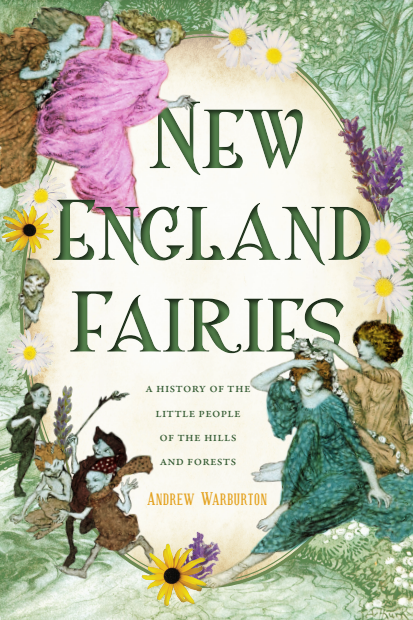
Note: Despite these accounts of the fairies’ departure, the Fairy Census of 2014-2017, published by the academic Simon Young, has collected numerous narratives of fairy sightings, suggesting the Fair Folk may have returned to New England. Or perhaps they never left.
 Fairies of New England: The Little People of the Hills and Forests
Leave a comment