
Native American Little People and European fairies are at times so similar it might be tempting to conclude they’re the same species. Nevertheless, Native American folklore is obviously not the same thing as European folklore, and stories about the Little People and the fairies arose in completely different contexts and cultures.
This only makes the similarities between them more remarkable, leading many people to weigh in on the subject, including the folklorist Charles Leland (who believed Native American folklore shared an origin with Norse mythology) and fairy expert Katherine Briggs (who speculated that Jesuits passed on a belief in fairies to the tribes they evangelized).
The fact is, Native American traditions deserve to be studied on their own terms, not interpreted as an offshoot of some other type of folklore. However, this doesn’t mean the similarities shouldn’t be explored.
What are these similarities?
(Note: for this post, I will be focusing on the Little People of the northeastern Algonquian tribes who inhabit present-day New England, or Dawnland, in the Algonquian language).
New England fairy abodes
American folklorists have come up with various ways to translate the Algonquian names of the Little People. This includes: Little People, elves, water sprites, water goblins, water fairies, and rock fairies. Of these, the term Little People appears to be the most common and most accurate. Nevertheless, the variety of translations points to the fact that some Little People are found in water (like the Wabanaki fairies and dwarves who occupy the rivers of New Hampshire and Maine) while others live in rocks or underground (like the Little People of Mohegan Hill in Connecticut). Similarly, British and Irish fairies are found in rocks, underground, in bodies of water, and in wetlands.
The nature and location of “fairyland”
“Fairyland” occupies an obscure location in both Native American and European lore. In Wampanoag (Massachusetts) and Mohegan (Connecticut) stories, one can only reach the fairies’ abode with great difficulty, whether via an arduous journey through a storm (at night) or by following a long flight of stairs underground. Sometimes the Little People require humans to cover their eyes before visiting their domain, as in one story from Mohegan Hill. This perhaps points to the necessity of giving up reliance on one’s senses if one wishes to penetrate the fairy realm.
Fairyland in Wampanoag folklore is described as a beautiful place full of “fruit and flowers.” Similarly, in European stories, one finds sumptuous palaces full of music, fine food, and wealth. In the latter tradition, the location’s beauty usually turns out to be an effect of enchantment, whereas no such illusory quality can be found in the homes of Algonquian Little People. In Britain and Ireland, illusion or “glamor” appears to be inherent to the life of the fairies; one might even go so far as to say that they seem to exist within (and appear satisfied by) a life of illusion. One can’t help concluding that Algonquian Little People are more concrete.
Organization of New England fairy society
The Mashpee Wampanoag on Cape Cod in Massachusetts describe the Little People’s social organization as mirroring, in many ways, their own community: the pukwudgies (an Algonquian name for the Little People) are organized in tribes with chiefs standing over each. They live in wetlands on the shores of Cape Cod and appear to be more warlike than the Wampanoag, their tribes composed of warrior bands with powerful arms and potent magic, which they’re not afraid to use against humans.
The Wampanoag of Martha’s Vineyard, on the other hand, describe the Little People as ruled by a wounded king whose princely heir wishes to take a mortal woman as his queen. These Little People have black skin and live underground in a paradise-like world.
In European folklore, we see a similar mirroring between human and fairy society. Fairy kings and queens rule over nations complete with courts, armies, and hunting bands.
New England fairy behavior:
Abduction of humans
Abducting humans is a favorite pastime of both Algonquian and European “fairies.” The Wabanaki peoples who live in Northern New England and Canada (including the Penobscot and the Passamaquoddy) believed the Little People could transform themselves into full-size men or women and seduce members of their tribes. Other fairylike beings, including Granny Squannit (which means old female spirit) in Southern New England and the lonely Maski’ksu (which means toad woman) in Northern New England, prefer to take children. European fairies similarly snatch humans for a variety of reasons (to wed, to enslave them, etc.).
Fairy reliance upon humans is found in both traditions. Just as British and Irish fairies employ human midwives, so the Little People enlist Mohegan and Wampanoag tribe members to heal members of their race. Making placatory offerings to the fairies can be found in both traditions (the Mohegans and the Wampanoag, for instance, leave baskets of food and tobacco). Finally, there’s the constant warning in both America and Europe not to speak too openly about the Little People for fear of offending them.
Collaboration with humans
The Passamaquoddy, who live at Pleasant Point in Eastern Maine, believed the Little People could collaborate with tribe members, thereby creating shamans. A shaman, for the Passamaquoddy, was someone who’d received magical powers from a “fairy” companion or familiar. The sign of a shaman was his ability to walk into the ground up to his knees, suggesting his great power.
Similarly, European fairies could bestow their magic upon humans, turning them into healers. Catching a fairy (such as a leprechaun) or gaining some fairy possession could bestow luck, wealth, or wishes upon mortals. In the same way, members of the Penobscot Nation in Maine believed that magical dwarves in the Penobscot River could bestow wishes on those who caught them.
More similarities:
Invisibility
The Little People of the northeastern tribes, like their European counterparts, are usually invisible to mortals and rarely wish to be seen. If a tribe member does come upon a group of Little People, as in the case of one Penobscot (Maine) hunter who caught two of them in his hands, it’s usually accidental. The Little People tend to respond with displeasure, attempting to cover their faces with their hands, as if being looked at is painful or threatening. This may reflect a belief in the spiritual power of the gaze. Other Little People, like those who live under Mohegan Hill, point at the person looking at them and then disappear. Many also have the ability to turn themselves into animals or wild beasts.
European fairies are equally private and usually remain invisible to humans. When a human does see a fairy (often by some devious means such as stealing fairy ointment), the fairy will sometimes take revenge, removing that person’s sight.
Size
In Algonquian folklore, the Little People are uniformly described as being the size of young children. Sometimes they’re called pygmy people, and their height usually falls somewhere between two and a half and three feet. European fairies, while often described as little, can also be human-sized. It’s sometimes said the term little people in the European tradition is a euphemism—a way to make potentially threatening supernatural beings appear less dangerous. Native American Little People, on the other hand, are so uniformly little that the “euphemism explanation” seems not to apply to them.
An important difference
The attitude of British and Irish fairies toward humans can be angry, mischievous, neutral, indifferent, or lustful. While they sometimes do help humans, this aspect of fairy behavior rarely seems altruistic and is often self-interested.
Algonquian Little People, on the other hand, are more ambivalent in their relations with humans. In the case of the Mohegans of Connecticut, the Little People often ask tribe members for food. If the Mohegans refuse, the Little People have the ability to freeze them on the spot and take what they want. Elsewhere, the Little People are said to have taught the Mohegans how to grow corn and tobacco. In the present day, the tribe believes the Little People live among the rocks on Mohegan land and continue to protect the tribe.
In Wabanaki folklore, the Little People have been known to help the tribes more directly, giving them information about potential dangers such as enemy raids, as in the case of two Penobscot hunters who came upon some Little People on a tributary of the Penobscot River. They also celebrate major events in the history of the Wabanaki tribes such as weddings or peace treaties. The Little People’s attitude toward their human neighbors is clearly more positive than that of their European counterparts.
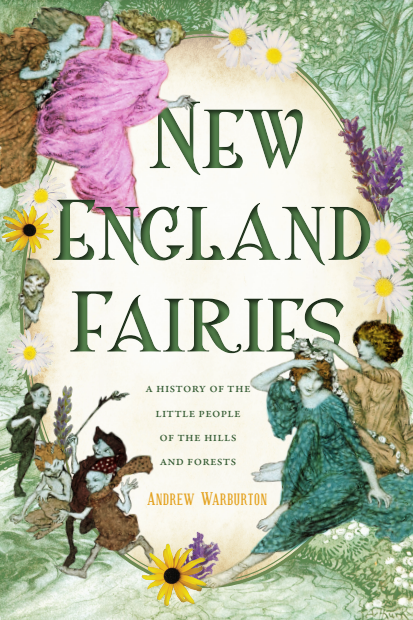
Read about more New England fairies in my book New England Fairies: A History of the Little People of the Hills and Forests.

 Fairies of New England: The Little People of the Hills and Forests
Leave a comment