Many authors on the Internet and in books on New England cryptids have taken to calling pukwudgies Massachusetts’ most famous magical “creature.” While I don’t doubt that pukwudgies are the most talked about Massachusetts fairy (in no small part due to J. K. Rowling’s inclusion of them in her Wizarding World), I think they’re a bit misunderstood.
Most of the talk about pukwudgies places them in the Freetown State Forest or Hockomock Swamp. Hikers and dog walkers who’ve encountered these beings describe them as troll-like humanoids with gray skin and porcupine quills. They appear to be solitary beings, and they sometimes follow people home. In my book New England Fairies: A History of the Little People of the Hills and Forests, I set out to show the novelty of these ideas and demonstrate that they differ a great deal from the original Massachusetts pukwudgies.

Who are the pukwudgies?
Folklorists have pointed out that stories about pukwudgies originated among the Ojibwe people in the Great Lakes region of the United States. For now I wish to limit my comments to the Massachusetts pukwudgies, a race of Little People found in the stories of the Wampanoag people of Mashpee on Cape Cod.
According to the earliest Wampanoag stories about pukwudgies, they live in the salt-water marshes around Popponesset Bay, south of Mashpee. A warlike people possessing powerful magic, they built houses among the tall marsh grasses and organized themselves into seven bands, a chief over each, with an even more powerful head chief (a great magician, according to the folklore) presiding over the seven lower.
It should be noted that nowhere in the earliest stories are the pukwudgies described as creatures, cryptids, or troll-like. Always they’re called little people or pygmy people. Furthermore, their tribal organization, with handfuls of pukwudgies forming smaller bands within the larger tribe, mirrors the Wampanoag’s own social organization, which again emphasizes their similarity to human beings.

A fallen tree among the marsh grasses of Popponesset Bay, home of the pukwudgies.
Pukwudgies are not solitary
The most important difference, in my opinion, between the original Massachusetts pukwudgie and the beings people encounter in the Freetown State Forest is that the latter are largely solitary. Hikers and dog walkers who’ve come upon them always describe them as standing alone in the forest. While such behavior might be the norm in a story about a cryptid (say, Bigfoot), it strikes me as odd that a magical being who operates in groups should always be encountered alone.
Pukwudgies in the Wampanoag stories were never described in isolation—always in bands. This reflected the Wampanoag’s own way of life, which for centuries comprised families and villages connected to a larger community.
Admittedly, the first pukwudgie, in Ojibwe folklore, was a man called Wa-Dais-Ais-Imid who remained the size of a child and withdrew into the woods to live among the mountains and rivers. He was the ancestor of all the pukwudgies. However, once the race was established, the pukwudgies lived and acted in groups.
A representation of white people
In his collection of Native American folklore from Southern New England, William Simmons pointed out that pukwudgies function in Wampanoag stories as thinly veiled stand-ins for white people.
This can be seen in their tormenting of the Wampanoag and their attack on the tribe’s magical protector Maushop, who represents the Wampanoag’s ancient way of life. Although the pukwudgies are small, their magic is powerful and turns out to be unstoppable. Maushop becomes so angry with them, he tries to drive them from Cape Cod. All these story elements reflect the Wampanoag’s justifiable resentments with white people.
The writer Stephen Gencarella has pointed out the irony of white men taking an Algonquian word (which originally referred to a folkloric representation of white people) and using it to describe a being that has little in common with the original Wampanoag source material:
It bears mention that almost all of the paranormal investigators of the [Bridgewater] Triangle and its Pukwudgies are white men. . . In a modern Wampanoag storytelling context, the tale of Pukwudgies who do evil was a critique of white people. One wonders what to think of contemporary white men telling tales about Pukwudgies who lurk in an area of land purportedly cursed by Indigenous people because whites seized something that did not belong to them.
Spooky Trails and Tall Tales Massachusetts: Hiking the State’s Legends, Hauntings, and History, p. 140.
The pukwudgies’ changing appearance
Let’s take a look at the pukwudgies’ changing appearance, as it’s a reminder of how much the modern pukwudgie differs from the portrayal that existed one hundred or so years ago.
In 1910, when an illustrated edition of The Song of Hiawatha was published, the pukwudgies appeared in the illustrations looking like little children or pygmies. These illustrations were not Ojibwe productions and may therefore require some analysis and correction. However, the pukwudgies’ appearance in these paintings seems much closer in spirit to the depiction found in the older folklore, for they are clearly Little People.
By 1982, when Jean Fritz published her influential children’s book The Good Giants and the Bad Pukwudgies, the pukwudgies resembled tiny gray-skinned trolls with large black manes. Ever since, people have portrayed pukwudgies as troll-like cryptids.
It should be noted that Rachel Sayet, a Mohegan Tribe member who wrote her master’s thesis on Mohegan folklore, has criticized Fritz’s book for its faulty depiction of Native American narratives:
The fact that Fritz does not consult with any tribal members before writing this book leads to significant problems. . . People from the Aquinnah Wampanoag tribe laugh when they hear about this book because it is so distorted from traditional Moshup stories.
“Moshup’s Continuance: Sovereignty and the Literature of the Land in the Aquinnah Wampanoag Nation,” p. 112.
If the modern portrayal of pukwudgies stems from this book (which seems likely, as I can find no earlier depictions of troll-like pukwudgies), is it the case that white paranormal investigators have based their questionable identification of pukwudgies on already questionable material? If so, we can probably conclude that J. K. Rowling’s depiction of pukwudgies as magical creatures (rather than Little People) has further compounded the problem.
The preeminence of Maushop
When I spoke to a young Wampanoag tour guide at the Aquinnah Cultural Center on Martha’s Vineyard, she stated she wasn’t familiar with Wampanoag stories about pukwudgies and instead emphasized the importance of Maushop to the tribe’s identity. The late Wampanoag elder Helen Manning, who wrote about the tribe’s folklore in the book Moshup’s Footsteps, left out any reference to the pukwudgies and focused on the friendly giant Maushop, his wife Squant, and their children. When it comes to folklore, the significance of Maushop to the Wampanoag’s history and way of life is clearly unparalleled.
What can we conclude about the role of pukwudgies in contemporary popular culture? Rather than showing an interest in Wampanoag folklore and its specific cultural meanings, people today tend to learn about pukwudgies from those who’ve taken an Algonquian word and used it in a way that reflects a lack of familiarity with its original context. If my recommendation is worth anything, I’d say: read Helen Manning’s book Moshup’s Footsteps rather than consuming trivialized and misappropriated elements of Wampanoag folklore. And perhaps it’s time we chose a different name for those mysterious troll-like dwellers in the Freetown State Forest: whatever they are, it’s unlikely they’re pukwudgies.
Pukwudgies, according to AI
I thought it might be interesting to see how modern-day artificial intelligence would depict the modern-day version of pukwudgies, so I wrote a prompt in the AI application Midjourney. The result can be seen below.
Is this how you imagine pukwudgies to be or do you prefer other depictions?
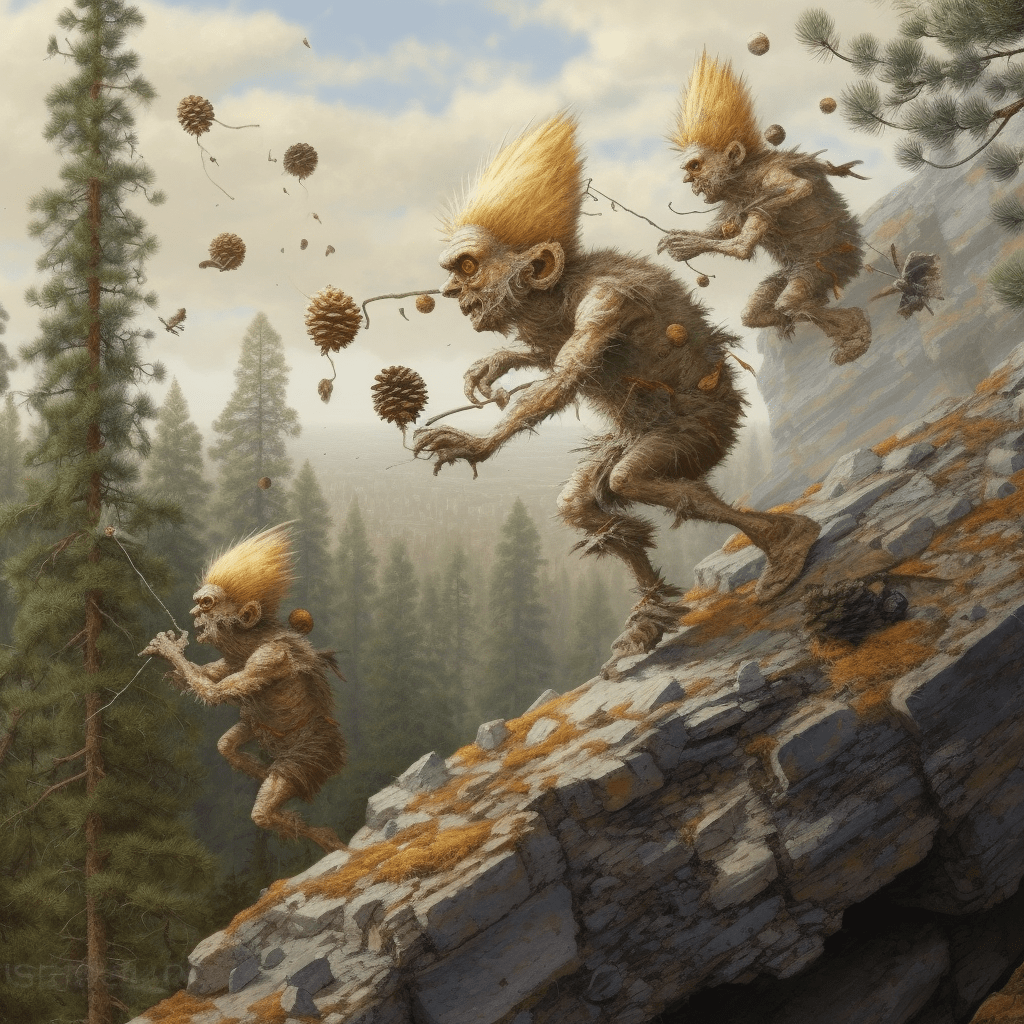
“Pukwudgies Throwing Pine Cones” by Midjourney


 Fairies of New England: The Little People of the Hills and Forests
Leave a comment