
The nature and substance of fairy bodies has fascinated folklorists, philosophers, poets, and occultists for hundreds of years. Perhaps because fairies demonstrate such power over the material world, people want to know what fairy bodies are made of. Are they disembodied spirits who only appear to have bodies? Or are they a generative race similar to humans but with magical powers? The first possibility cannot be ruled out, because fairies are skilled enchanters. But equally, folklore offers much evidence of fairy physicality. The answer to these questions will, of course, depend on the folkloric tradition being examined.
Here I want to touch on the tradition of fairy incorporeality before contrasting this tradition with the evidence of New England folklore, where fairies are mainly corporeal beings (i.e., possessing weighty bodies). Central to the question of fairy bodies is the use of tools, for tools are indicative of concrete engagement with the material world. Of course, the very notion of corporeality and incorporeality becomes somewhat fuzzy when talking about fairy bodies, as we’ll see.
Traditions of (in)corporeality
Throughout history, literary traditions have often (not always) depicted fairies as spirits with a thin or tenuous corporeality. This is especially true of spiritualists, theosophists, and other occultists, who’ve sought to reconcile ideas about elementals (i.e., spirits of earth, air, fire, and water) with fairy traditions. These ideas originated among Renaissance alchemists and magicians such as Paracelsus and Cornelius Agrippa, although they ultimately derive from ancient hermeticism and neoplatonism. This tradition perhaps reached its literary zenith in Shakespeare’s A Midsummer Night’s Dream, which later influenced the Romantics and Victorians.
A twentieth-century description of tenuous corporeality can be found in the work of theosophist Dora Kunz, who claimed the green fairies of the New Hampshire woods were “gaseous” beings composed of “pure feeling,” their motions expressions of their “wishes and desires.” In the following quote from Kunz’s The Real World of Fairies, the fairy body takes a definite form but is made of a type of “matter” or “living substance” undetectable to human scientists:
His body is made of matter in a state much more like vapor than anything else we know of in our world but the form is quite definite and lasting. The material of his body is as loosely knit as the vapor from the spout of a boiling tea kettle, and is somewhat of the nature of a cloud of coloured gas. In fact, it is exactly that, only the gas is finer than the lightest we know, and is less readily detected even than helium or hydrogen. But this does not prevent it from being held together in a form, for it is not a chemical but a living substance, which life saturates and holds together.
While the emphasis on incorporeality or thin corporeality doesn’t necessarily contradict fairy folklore (fairies are sometimes called spirits in folklore, and as early as the seventeenth century, Scottish fairy observer Robert Kirk said they possessed bodies of “congealed air”), the emphasis on spirit over matter represents a competing orientation within fairy belief. It exists alongside other traditions of more clearly corporeal fairies. Furthermore, Kunz’s emphasis on “feeling” or “vital matter” as the constituent fabric of fairy bodies is more sentimental than the observations found in the more “corporeal” traditions.
New England fairy bodies
Long before theosophy “spiritualized” fairy bodies, the fairies of New England folklore possessed physical bodies and even used material tools. This is true of the European fairies who migrated to New England and the Native American Little People who’d always been here.
But what kind of tools did New England fairies use? And what do these tools say about the nature of their bodies?
One example can be seen in the fairies of South West England who emerged in Marblehead, Massachusetts. The existence of these fairies in Marblehead folklore was first attested in the early nineteenth century, but they may have been present in the town for as long as there were English storytellers there to speak about them (from about 1635). These fairies clearly possessed physical bodies because they drank (presumably rain water) from cups made of red lichens. It’s likely these were the British soldier lichens that grow in Massachusetts, so-called for their color’s similarity to the British redcoats. Although these “cups” were natural objects, the fairies used them as tools.

British soldier lichen. Photo by Dmytro Leontyev. License.
Marblehead’s English or Cornish fairies sported at night, and although they lived in underground palaces, they sometimes fell asleep among the flowers at dawn, suggesting their bodies required rest and rejuvenation. Their drinking of water perhaps lends itself to two interpretations: either they were physical beings who required hydration or spiritual beings capable of extracting life force from matter (rather like the lamia who drinks blood). The latter interpretation isn’t exactly in keeping with the spirit of Marblehead folklore, though.
Algonquian fairy objects
In the Algonquian legends of the Northeast, on the other hand, fairy beings (like the Little People) appear to be entirely corporeal. Wabanaki storytellers described their bodies in detail, from their large, aquiline noses to their A-shaped mouths to their beautiful black hair. (That these features are physical attributes, rather than an effect of enchantment, is clear from the testimony of early-nineteenth-century Penobscot storyteller Sauk Ketch, who claimed to have caught two Little People in his hands). More recently, people have described the Little People as “spirits,” but in the nineteenth century they were usually depicted as physical beings who even used tools.
The use of tools seems to me to be an attribute of beings who interact physically with the world. If fairies use tools, it suggests to me they’re physical beings. Furthermore, an examination of their tools can tell us more about the nature of their bodies.
The following magical objects (six in total) appear in the stories of the New England Algonquian tribes, including the Mohegans, Penobscot, and Passamaquoddy. What do these objects reveal about the nature of fairy bodies in New England folklore?
Cooking pots
In the folklore of the Penobscot people in Maine, the dwarves (alombegwinosis) who lived in the Penobscot River used tiny cooking pots in which they placed a kernel of corn (the pots were so tiny, it’s all that could fit). When the kernel finished cooking, it produced far more than anyone could eat.
According to one story, a female dwarf given in marriage to a Penobscot man brought a cooking pot with her when she came to live in the man’s home. After placing a kernel of corn in the pot, the kernel produced an enormous amount of food, astonishing the Wabanaki man.
The story reflects the abundance of corn, a staple food of the Algonquian tribes, in precolonial and postcolonial New England. It also suggests that the dwarves were physical beings who drew sustenance from the same source as the Penobscot (i.e., corn).
Belts
Two magical belts can be found in the Algonquian legends of the Northeast.
The first belonged to Glooskap, a divine lord and hero in Wabanaki folklore. The belt protected Glooskap from all manner of dangers, including hunger and sickness. He sometimes lent it to his adopted younger brother, a woodland fairy called Marten (Apistanewj in the Algonquian language). When Marten tied the belt around his waist, it gave him superhuman strength and the ability to hunt successfully at all times.
The second belt has a tangible existence and can be seen today at the Tantaquidgeon Museum on Mohegan Hill in Uncasville, Connecticut. This is the belt Fidelia Fielding, last fluent speaker of the Mohegan language, received from her grandmother Martha Uncas in the nineteenth century. Martha was said to have received the belt in the eighteenth century from the Little People who live under Mohegan Hill. For the Mohegans, the belt is important because it
carries the spirits, language, symbols, stories, and worldview of the women who passed it on, as well as their connection to flora, fauna, rocks, spirit beings, and the Makiawisug woodland little people.
The belt can be viewed online here or in person at the Tantaquidgeon Museum.
Magic pipes
The mikummwessuk or Little People who lived among the Passamaquoddy of Eastern Maine possessed innate magical powers, including the ability to transform themselves into wild beasts. They also used magical pipes or flutes to enchant large animals and bewitch Passamaquoddy women.
The most famous fairy pipe in Algonquian folklore is the one Glooskap gave to Little Thunder, a Wabanaki man who longed to be a fairy. Glooskap bestowed the pipe at the end of a mystical initiation during which the man gained the powers of the mikummwessuk. Little Thunder used the pipe to perform his greatest feat: hypnotizing a giant golden serpent and cutting off its head.
In keeping with the story of the man who became a mikummwess, the Little People sometimes gave their pipes to humans, thereby transforming them into powerful shamans or even fairies.
Stone canoes
The wenagameswook of Maine and the manogemassak of Vermont (American folklorists have translated these words as water fairies) were known to navigate the rivers and wetlands of Northern New England in stone canoes.
Stone canoes are a mark of spiritual power or divinity in Algonquian folklore, for the great lord Glooskap traveled in one himself. These magical vessels are paradoxical, suggesting the Little People required a mode of transportation to navigate the land but also possessed power over the forces of nature that make travel possible. For the fairies could imbue stone with the buoyancy of birch bark, the traditional material of Wabanaki canoes. The paradoxical relationship between nature and magic in this legendary account is suggestive, perhaps more than anything else, of the Little People’s mysterious nature.
Marten’s birch-bark dish
In Passamaquoddy and Mi’kmaq folklore, the mikummwess or wood fairy called Marten lived with Glooskap and accompanied him on many amazing adventures through the lands of the Wabanaki people.
Although Marten sometimes wore Glooskap’s belt, which gave him superhuman strength, he didn’t possess all Glooskap’s powers. This meant he was vulnerable to harm, and on a few occasions, he found himself in trouble and even died, forcing Glooskap to resurrect him. Marten’s vulnerability meant it was important for Glooskap to know where he was at all times, especially if he was on an adventure. One way Marten communicated with Glooskap was via a magical birch-bark dish. All it took for Glooskap to learn Marten’s location was to look in the dish, and he could see him.

A First Nations birch-bark container. Photo by Jason Zhang. License.
Birch bark is one of the most important materials in Wabanaki culture and remains significant in Wabanaki crafts. The tribes used the bark to create canoes, wigwams, and domestic items like dishes and wall containers.
Clay concretions
In the folklore of the Abenaki people of New Hampshire and Vermont, the water fairies who lived near Button Bay on Lake Champlain and along the Connecticut River were particularly busy at night.
During the night, they went to work making magical clay sculptures of humans and animals. They left these on Lake Champlain’s shores and along riverbanks for the Abenaki to find. The fairies imbued the sculptures with luck, a sign of their care for the Abenaki people.
Visitors to Button Bay in Vermont can see these sculptures in the museum located at the tip of Button Point. From a geological perspective, the “sculptures” are called concretions. They’re formed when clay becomes stuck to a piece of plant matter or a shell. Calcium hardens the clay, and the organic matter decays, leaving behind a mold.
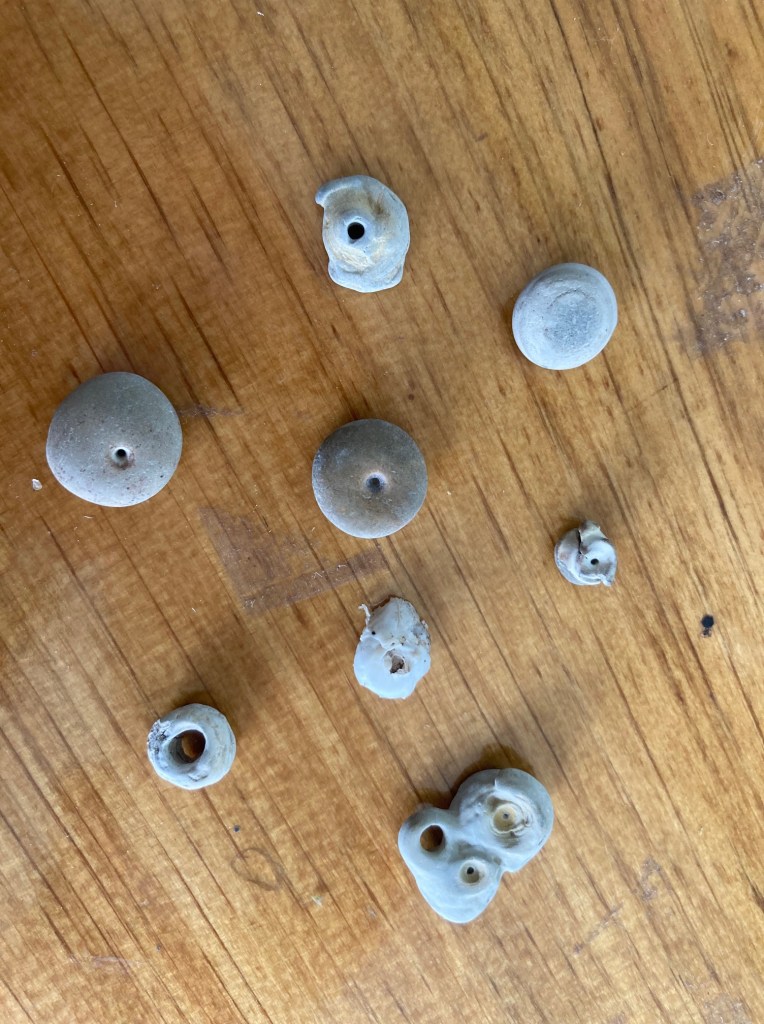
Concretions attributed to the Little People of Lake Champlain, Vermont.
Conclusion
What do these objects tells us about the bodies of the fairies found in Algonquian folklore?
- Fairy bodies require sustenance, which they gain from the same source as the Algonquian tribes, i.e., corn. They also need to cook food before consuming it. In the nineteenth century, the Mohegans demonstrated their understanding of this when they left out baskets of corn as offerings to the Little People.
- Fairy bodies require tools (canoes) to navigate the land. However, the Little People interact with the forces of nature in a mysterious way, practicing a form of magic that transcends but respects the natural world’s laws (i.e., they imbue stone with a marvelous buoyancy but nevertheless travel by water).
- The fairies make decorative items such as human-sized belts and tiny sculptures, which they give to humans. Clearly, they can manipulate matter and don’t need to rely on enchantment.
- The fairies depend on magical objects such as pipes and belts. Without these objects, fairy bodies are vulnerable to weakness, failure, starvation, and death.
- The fairies and the Wabanaki use the same materials, such as birch bark, and the same tools, such as canoes and cooking pots. Unlike the Wabanaki, the fairies imbue these with magical powers.
The objects and tools in Algonquian legends suggest the Little People possess a similar corporeality to the Alonquian peoples. Not only do they live alongside humans (though usually hidden from them), they eat the same food and interact with similar objects. However, the Little People’s corporeality appears to be less burdensome to them than it is to human beings, because they imbue their objects with magical powers and possess innate abilities. Yet even these powers are accessible to humans, transforming them into shamans or fairies.
Allegorical meanings
It might be interesting to consider how these findings about Algonquian fairy bodies relate to an understanding of the Little People as spirits with thin or absent corporeality. It seems to me that an understanding of fairies as spirits lends itself to allegorical readings of folklore. How else can one reconcile folkloric stories of corporeal fairies (who use concrete tools and objects) with the spirit-nature of, say, Little People?
An allegorical reading of Algonquian legend might, for example, interpret the magical corn-multiplying pots of Penobscot dwarves as symbolizing the Little People’s spiritual role of guaranteeing the natural world’s abundance. According to this interpretation, the Little People are integral to the natural world and beneficial to human beings. One might go further to suggest that the Little People represent the natural world as bountiful, i.e., the lavish, gift-giving aspect of the natural world. According to this spiritual principle, which reflects a hidden, spiritual reality, nature’s generosity is more than merely accidental but is invested in human well-being. Rather than being an indifferent assembly of vegetables, minerals, and animals, nature is relational.
In the case of clay concretions, or sculptures left by water fairies, the allegorical meaning of the magical phenomenon relates to luck and blessing, for the Abenaki considered them to be charm-like. It’s likely that the Little People’s sculptures are an extension of nature’s bountiful aspect: by shaping supposedly indifferent materials (clay, vegetable matter, and calcium) into artistic shapes, the Little People demonstrate their creative role, which is also the creative aspect of nature. When someone finds a clay concretion, they perhaps receive a pledge that the Little People are present and that nature is oriented toward their well-being. In this way, the Little People’s presence is a blessing.
Read about more New England fairies in my book New England Fairies: A History of the Little People of the Hills and Forests.


 Fairies of New England: The Little People of the Hills and Forests
Leave a comment