
The first large-scale collection of Irish American fairy lore in New England appears to have been compiled quite late. Unlike in New York, where the folklorist Louis C. Jones collected Irish Little People stories in the 1940s, it wasn’t until the 1980s that folklorist E. Moore Quinn began to collect a great deal of Irish American folklore in New England. Quinn’s findings—published in the volume Irish American Folklore in New England (2009)—are based on the memories of her elderly informants, second and third generation immigrants whose parents and grandparents came to New England in the post-Famine era (i.e., between 1852 and 1914). For this reason, they mainly take the form of remembered sayings, necessarily disconnected from their point of origin.
The fairies appear often in Quinn’s findings, demonstrating that many elderly Irish Americans at the end of the twentieth century could remember their parents and grandparents talking about the Little People. Importantly, Quinn points out that the most abundant folklore in Ireland (collected in the 1930s) came from the Irish-speaking parts of the country, and it was “from these areas that vast numbers of immigrants to New England originally hailed.” In other words, New England’s Irish American culture was probably quite rich in fairy lore.
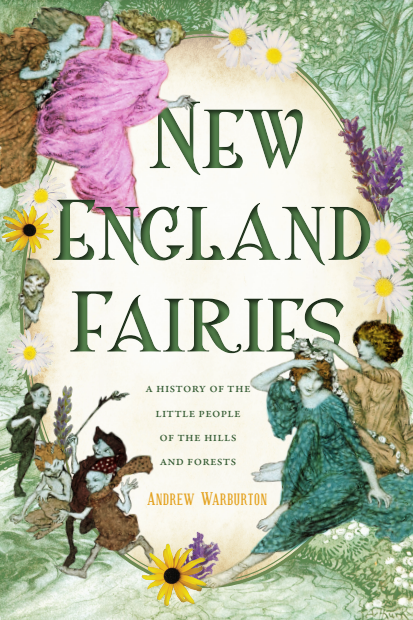
Below, I summarize Quinn’s fairy-related findings as a resource for those interested in New England fairy lore, specifically of the Irish variety. The findings also complement the chapter on Rhode Island in my book New England Fairies, providing a wider context for some of the stories shared there.
E. Moore Quinn’s fairy-related findings:
- A South Boston man claimed that his father “often blamed the fairies for mischief” but also “believed in their occasional goodness” (Quinn 164). The man’s father credited the fairies with saving him and two other men when the boat they were sailing was caught in a storm. They discovered that one of the sails, which they were desperate to lower, had already been taken down and folded, as if by magic.
- Some informants reported their parents and grandparents praising an “unknown ‘good fairy’” when a child performed an “unexpected ‘good deed’” (164).
- Some informants remembered the “parlor” of the house being called the “west room” and being “off limits,” i.e., saved for meeting with the “doctor” or “priest” or for holding wakes (195). Quinn connects the west room’s importance to the fact that the Irish associated the west with fairies. In Irish folklore, one finds a taboo against building “an additional room on the west end of a house,” for it was believed the room would be in the fairies’ way (195).
- One woman reported she could remember learning, as a child, the William Allingham poem, “Up the Airy Mountain,” which describes a fear of going hunting due to the presence of the “little men,” “the wee folk,” “the good folk” (218). Quinn speculates that the teacher’s choice of poem suggests she may have been “imbued with the culture of fairy folk belief” (219).
- One informant told Quinn: “Never throw out water at night—you’ll wet the fairies” (219), a common idea in Irish and British folklore.
- Some informants subscribed to the notion (widely held in Ireland) that the fairies will stay away from an “unclean house” (219).
- Some informants, instead of referring to the fairies directly, used the term they and them (for fear of causing offense), thereby following the traditional Irish way (219).
- Certain spaces and times were believed to be reserved for the fairies, including nighttime. One informant remembered her grandfather saying he didn’t like to be outside after dusk or before dawn, for “they were about” (219).
- The most commonly remembered “household practice” among the informants was “leaving something out for the fairies” (220). This involved “leaving the last thing on one’s plate” for the fairies (whether on the table or on the mantelpiece). A related practice was “never clearing the table after Midnight Mass” in case the fairies desired the leftovers. One man recalled his father leaving a “scone and a bit of brown bread” for the fairies (220).
- One woman remembered the saying, “Never pull an apple off an apple tree after Halloween” because “they are for the fairies” (221).
- Other informants recalled their relatives saying, “it must have been the fairies” or “it must have been the little people,” when “something went missing or awry” or when the weather was “changeable or unpleasant” (230).
- Another informant described a belief that “whirlwinds or dust devils were really the ‘little people.’” In the same context, Quinn describes the “notion of the fairies being ‘caught up in the wind’” as “common” (231).
- One informant recalled a female relative telling stories about the “pooka,” a mischievous spirit or goblin (224).
- Regarding wakes, informants remembered being told not to “turn one’s back on the body” or leave “the deceased unattended” for “fear that the fairies (or devils) would carry off the body” (247).
- Many informants recalled their relatives telling stories about banshees and leprechauns. One woman remembered her female relative saying she’d actually heard the banshee (249).
- A Sister of Mercy in New Hampshire explained the belief that “some of the old Irish families had fairies for ancestors.” The same nun claimed she’d heard the banshee “last Friday night… in the middle of the storm” and that when she wrote to her cousin, she learned an uncle had died (249-250).
- One informant explained that when a rooster was heard crowing or a dog howling at night, people would say it was the banshee keening (250).
Conclusion
It’s often said that Old World fairy folklore never took root in the United States. While it’s true to say that real-life fairy experiences on American soil are sporadic to say the least, Quinn’s findings suggest that many Irish Americans brought their fairy lore with them to New England and passed that lore on to their children and grandchildren. By the end of the twentieth century, the descendants of these initial immigrants tended to remember this lore in the form of fragmented ideas and half-understood sayings. The context in which these ideas made sense—often rural Western Ireland—was a far cry from the overcrowded tenements of East Coast cities. They did, however, remember the Good Folk, and some practices (including leaving food for the fairies) continued on American soil. To read about an Irishwoman’s sighting of banshees in nineteenth-century Rhode Island, check out my book New England Fairies.
Quinn, E. Moore. Irish American Folklore in New England. Washington, D.C.: Academica Press, 2009.
 Fairies of New England: The Little People of the Hills and Forests
Leave a comment