Today I want to share a photograph that might help illuminate the numerous nineteenth-century sources in which residents of Marblehead, Massachusetts, are described as possessing a belief in pixies.
NB. We’re indebted to folklorists Peter Muise and Stephen Gencarella for drawing attention to these sources.
It’s thought that fishermen from Devon, Somerset, and Cornwall brought pixie folklore to the North Shore of Massachusetts in the seventeenth, eighteenth, or early nineteenth century. Mention of Marblehead’s “Devonshire pixies” can be found in the 1851 autobiography of Supreme Court Justice Joseph Story; an 1869 copy of the Springfield Republican (where “naughty fairies” are said to “pixilate” people, that is, lead them astray at night); and an 1894 issue of the Journal of American Folklore (where an elderly, “well-educated” woman describes the pixies as “little brown men”).
Despite this evidence of belief in pixies in nineteenth-century Marblehead, information about the precise locations where the pixies lived is few and far between. Knowledge of one location has, however, been preserved.
The Three Sisters
Thanks to folklorist Stephen Gencarella—who discovered an article about the pixies in the Columbian Centinel dated September 4, 1839—we know of at least one historical pixie haunt in the town. In that article, we learn from a writer called “Nauticus” that “many spots about Marblehead” were “famous” for being “the resort of these fantastic creations,” but only one is actually named.
This is the site of “the Three Sisters”—three glacial boulders that stood, in 1839, at the corner of Green Street and Waterside Road. Unfortunately, the boulders are no longer there,1 and today the site is a patch of trees in a quiet residential neighborhood, but in 1839, the site was a “lonely and secluded place”—just the kind of “wild” location where people might fear the pixies.
Nauticus claimed that the Three Sisters owed their existence to a giant boulder once “cleaved by a bolt of irresistible lighting.” “Ancient willows” shadowed the intersection of the two roads, suggesting that Marblehead’s pixies liked secluded, lightning-blasted places with a certain amount of shade. Thanks to the Marblehead Historical Commission—in particular, its preservation of an old, undated photograph—we know what the site may have looked like when the pixies were still there. The three figures found in the image below provide useful perspective demonstrating the boulders’ sheer size. Do you think the pixies are still there?
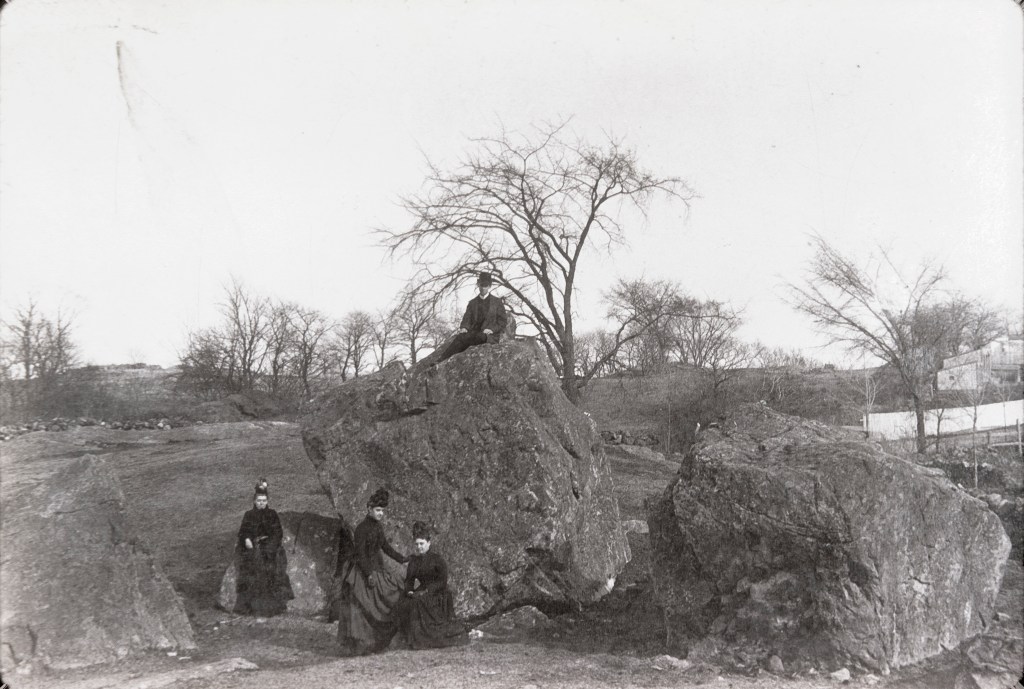
Image courtesy of the Marblehead Historical Commission, Abbot Hall, Marblehead, MA, Object ID: 1961-002-03231, http://www.marbleheadhistory.com
Read about more New England fairies in my book New England Fairies: A History of the Little People of the Hills and Forests. Also available at your local bookstore.
- The Marblehead Historical Commission says the boulders were “removed” but doesn’t give further information. ↩︎
 Fairies of New England: The Little People of the Hills and Forests
Leave a comment