In English folklore, it’s a well-known fact that fairies (or elves, as they were called) had the ability to cause illness in humans and animals. In Anglo-Saxon medical texts, writers offered remedies such as adding holy water to animal feed to protect livestock from elfin enchantment. Similar themes can be found in Irish and Scottish folklore as well. (In Stith Thompson’s Motif-Index of Folk-Literature, the “fairies cause disease” motif is code F362, for those interested.)
In the eastern United States, one finds a handful of stories about fairies causing disease—some brought to America by Scottish immigrants, others Indigenous in nature. Here I offer a summary of these sources for the purpose of further study.
In my forthcoming book Fairies of Northern Appalachia, I write about the folktale “The Witchie Folk,” which folklorist James York Glimm identified as an example of the fairies-cause-disease motif. That story comes from Scotland via West Virginia and Pennsylvania and involves a strange, magical clan of “people” supposedly causing illness in an Appalachian valley. I won’t spoil what happens in the story, but it suggests that some folks in West Virginia’s Allegheny Mountains were aware of the notion of magical beings causing disease. (In Appalachia, this idea appears to have intersected with other beliefs about malevolent witches and, conversely, faith healing).
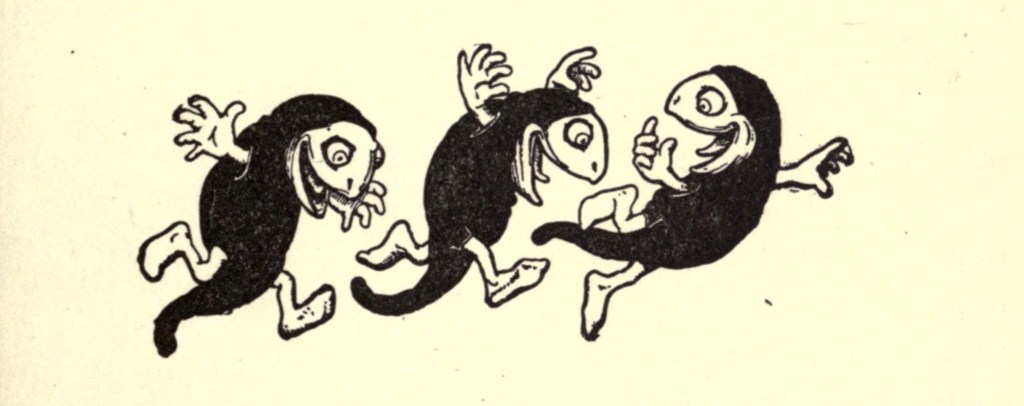
Another folktale in which fairies appear to be associated with disease is “The Hobyahs.” A children’s bedtime story about malicious hobgoblins attacking a family home, “The Hobyahs” originated in Scotland but spread to Washington D.C. and Pennsylvania some time prior to the twentieth century. When folklorist Joseph Jacobs published the story in his More English Fairy Tales, the Hobyah illustrations that accompanied his text (by artist John D. Batten) reminded Jacobs of the comma bacillus bacteria (the cause of cholera). This is because both the bacteria and Batten’s Hobyahs have a comma-like shape (see below).
A band of human-eating goblins that kill members of a family one by one, the Hobyahs are certainly an appropriate metaphor for cholera. Although the Scots immigrants who settled in Pennsylvania may not have made the same connection between the Hobyahs and disease, the story surely gained extra resonance from the cholera pandemics that ravaged family homes in the nineteenth century. If the Hobyahs are a metaphor for cholera, it means that the fairies-cause-disease motif has been transformed, in this instance, into a fairies-are-disease motif!

John D. Batten’s illustration of the comma bacillus-shaped Hobyahs.
In the Cumberland Mountains of eastern Kentucky, we find perhaps the most concrete example of fairies causing disease in the eastern United States: the story of postman Tom Fields whose horse was shot by the fairies some time in the early twentieth century. Reflecting the ancient fairy beliefs of Scotland and England, Tom thought that a fairy arrowhead had caused his horse to become lame. The arrowhead he found, which he regarded as a protective charm, was probably made by the Cherokee or their ancient ancestors, but to Tom, only the fairies could have made it.
Whether the notion of “elf-shot” and the existence of magical arrowheads was ever widely associated with fairies in Appalachia is unclear: in 1894, folklorist J. Hampden Porter listed “elf-shot” as a common fear in the Allegheny Mountains, but he left the agent of the elf-shot unnamed and didn’t explain whether people actually used the term. Nevertheless, historian James Adair, in his 1775 History of the American Indian, did comment on the similarity between Cherokee arrowheads and European “fairy arrowheads,” suggesting that the connection was easily made. Adair explained that his Irish ancestors had not only believed that fairies shot their cows but that fairy arrowheads could be used as a remedy for the enchantment. In Kentucky, Tom Fields’ use of his own fairy arrowhead as a “charm” may represent a late manifestation of this belief.
An example from Senecan folklore
In the context of Seneca folklore and religion, the Little People were sometimes believed to cause disease in those who failed to propitiate them correctly. Evidence of this can be found in the opening invocation of the “Dark Dance of the Little People” ceremony, which writer Edmund Wilson transcribed in his 1959 book Apologies to the Iroquois. There we find the words:
You [the Little People] are the cause of a person, a member, becoming ill… [So let this illness cease].
The Dark Dance was an important way for members of the Seneca Dark Dance Society to establish and maintain a relationship with the Little People. If a member fell sick as a result of the Little People’s actions, the Dark Dance Society organized a Dark Dance ceremony to invoke the Little People, who’d then heal the ill member.
In 1936, Seneca writer and artist Jesse Cornplanter explained that he’d inherited a powerful “animal charm” from his ancestors, which required him to perform the Dark Dance ceremony. When he performed the ceremony appropriately, the charm ensured that he and his family remained in good health. However, if he failed to perform it, the Little People would cause him to become sick. Here we see an example of the Little People being associated not only with illness but also, paradoxically, with good health.
Conclusion
This is the extent of the direct association I’ve found between fairies and disease in the eastern United States. Hopefully, this post can serve as a starting point for further research on the subject. One example of an avenue for future research was suggested to me recently by a graduate student in Nyack, New York. She explained that while researching the medical records of old tuberculosis hospitals in New York City, she’d come across various references to doctors educating Italian immigrants in good hygiene practices. One example of “bad hygiene” for these doctors was the immigrants’ habit of keeping windows closed at night despite living alongside sick relatives. Their reasoning for doing this was that it prevented “evil spirits” from entering their apartments and spreading disease. It’s possible that Irish immigrants in New York City believed similar things about the fairies.
Although we find other examples of fairies (such as banshees in Rhode Island) being associated with illness (such as cholera and tuberculosis), these examples relate only tangentially to the motif in question, for banshees never cause disease, only accompany or presage it.
 Fairies of New England: The Little People of the Hills and Forests
Leave a comment