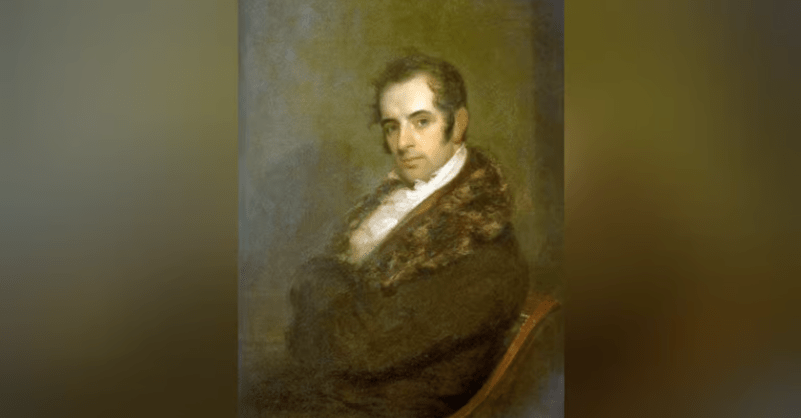
In my book New York Fairies, I’ve tried to recreate the folkloric atmosphere of the Hudson Valley, which Washington Irving must have drawn on when writing stories like “Rip Van Winkle” and “The Storm-Ship” in the early nineteenth century. The theory is that Irving’s depiction of the Heer of Dunderberg (a goblin king) and his army of imps must have had precursors in Dutch American folklore. Well, I was recently recommended a new book that makes it easier to connect Irving’s creations with actual Dutch folklore: The Dutch World of Washington Irving by Elisabeth Paling Funk.
Funk uses her Dutch language expertise and knowledge of Dutch sources (of the Netherlands and New Netherland) to show that Irving faithfully recorded aspects of Dutch folklife in his A History of New York.

Although Funk doesn’t write a great deal about Dutch fairy lore, she does point out that the Dunderberg imps from Irving’s “The Storm-Ship” may also appear in his A History of New York. There, Irving refers to “merry roistering devils frisking and curvetting on a huge flat rock. . . called the Duyvel’s Dans-Kamer” (“the Devil’s Dance Chamber”).
Today, Danskammer Point lies near Newburgh and is unfortunately off-limits—home to a power station. The “huge flat rock” mentioned in the story is gone now, having been destroyed in a shipping accident. We learn here that the Dutch navigator David Peterz de Vries first mentioned the Point in April 1640 “when he saw a group of Indians dancing in the firelight on the flat rock that jutted into the Hudson.” This is apparently what gave rise to the Danskammer name. Irving, however, changed the story of the Point’s naming when he claimed that the aforementioned “gang of merry roistering devils” had “horribly frightened” Peter Stuyvesant and his crew when they sailed up the Hudson River.
Funk implies that Irving’s portrayal of the “devils” faithfully transmits aspects of Dutch fairy lore: not only does she point out that these devils recall the imps of Dunderberg, but she also situates both devils and imps in the context of Dutch folklore about kaboutermannekin (imps, elves, or “earth demons”). “A Flemish tale that resembles the History‘s incident,” she writes, “concerns malevolent elves who were able to disappear in a wink, yet were observed dancing on their elbows with their legs in the air.”
The tale Funk refers to can be found in a collection of folklore from the Brabant region called Brabantsch Sagenboek. There, we find the story of little men (Laplanders or kaboutermannekin) who, according to Funk, “may be helpful, mischievous, or evil” and can disappear in the “blink of an eye.” They resemble Irving’s literary creations most clearly when drinking and dancing around on their elbows with their legs in the air. One can assume such stories reached the shores of the Hudson River sometime in the early seventeenth century.
Another tale from the same collection has even clearer parallels with Irving’s story of the Dunderberg imps. In that tale, the kaboutermannekin have a “king” (Kyrië) and hollow out a mountain called Kabouterberg in Brabant. Unlike Irving’s imps, they spend their time stealing game and cattle from Dutch villagers. These kaboutermannekin originally beat men who come too close to their Kabouterberg home, but they take pity on young lovers who come to them for help, and they’re eventually driven away beyond the Rhine. In Brabant, locations are named after these kaboutermannekin, for they originally lived in the Campine region of that province. (Unfortunately, similar names don’t appear in old Dutch maps of the Hudson Valley, as far as I’m aware.)
Besides her knowledge of kaboutermannekin tales, Funk also offers insight into Irving’s strange depiction, in “Rip Van Winkle,” of Henry Hudson’s crew. Although illustrators like Arthur Rackham and writers like Charles Montgomery Skinner came to interpret Irving’s “men of the mountains” as representing gnome-like beings, Irving’s descriptions actually echoed aspects of Dutch genre paintings, for, according to Funk, these paintings give their subjects “peculiar, disproportionate features.” Irving’s vision of seventeenth-century Dutchmen was most likely filtered through his knowledge of such paintings.
What can we conclude from all this? Well, Funk’s work supports the supposition that folklore about kabouters did underlie Irving’s stories about imps and devils. Whether Dutch settlers of the Hudson Valley really saw Dunderberg as a “New World” Kabouterberg—or whether Irving merely wanted it to be so—is unclear. We can conclude, though, that our present-day understanding of “Catskill gnomes” (the men of the mountains in “Rip Van Winkle”) developed (through misrepresentation) out of Irving’s echoing of a painterly form of representation.
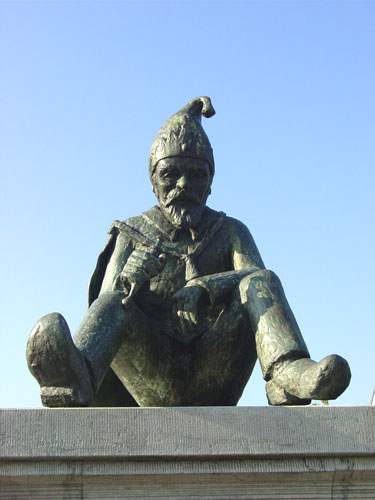
Gnome king statue in Hoogeloon, the Netherlands, photographed by Peter Maas. License.


 Fairies of New England: The Little People of the Hills and Forests
Leave a comment