In the modern day, we tend to think of ghosts as autonomous entities or “traces,” existing independently of those who observe them. This idea is especially common in the paranormal community, where people tend to investigate ghosts as if they were verifiable objects of study.
The British folk ballad tradition teaches something quite different. Rather than being an independent entity, a ghost in that tradition is often implicitly tied to the love of the one who sees the ghost. Always relational, the ghost is what floats in to fill the void opened up by the loss of the loved person. This means that the ghost is inseparable from the grieving person, is inexorably drawn toward them, and is perhaps even summoned by their grief. In this way, the ghostly encounter is more in the nature of a vision than a concrete meeting.
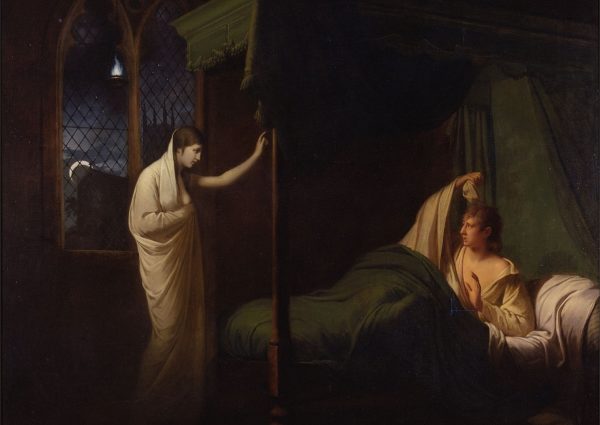
Take Roud 22567 (sometimes known as “Willy O!” or “The Bay of Biscay”). We find there a dead sailor, Willy, who’s allowed to visit his lover Mary and offer her one last “glimpse” of him before departing at the cockcrow. There’s a sense in which the ghostly description of Willy’s cheeks (“as white as snow,” instead of “blushing”) speaks more to the nature of Mary’s love (tending toward the ghostly) than to the nature of the ghost itself. Stating repeatedly that Mary waited “seven long years” to see her Willy again, the ballad implies that the ghost’s visit is merely the conclusion of the story of her love.
Take also Child 74, Roud 861, and Child 272, where, in every instance, the appearance of the ghost is merely the crowning episode of a love story. In each case, the ghost bears witness to the painful reality that love outlives the death of the loved person. Where once love tended toward the living, it now yearns for the dead, even seeks to resuscitate the dead.
In Roud 861, we hear that the ghost of the narrator’s fiance comes “so softly” into his room that “her feet made no din.” Altering the meaning of the term “wedding day” so that it refers to her living lover’s future death, the ghost informs the lover that it “won’t be long till our wedding day,” that is, the consummation of their love in the afterlife. In Child 272, we find a visit from a ghost who takes his living lover on an otherworldly ride (“faster than any wind”)—that is, until the latter realizes that the former is as “cold as any clay.” Undoubtedly, these descriptions (of coldness, paleness, softness, and silence) do attest to a genuine belief in ghosts in early-modern Britain. In the context of the ballad tradition, though, this belief is clearly invoked to explore the nature of a love that, having lost its object, continues to love a ghostly thing.
Sometimes, we find that the ghost motif is used to warn of the uselessness of a love that has such an object. In Child 78, a lover mourns on his dead love’s grave for twelve months and a day. The lover’s grief finally has the effect of summoning the loved one’s ghost. After complaining that his weeping has prevented her from sleeping (his tears having wet her burial shroud), the ghost urges the man to leave off weeping and live a peaceful life. Although people in Britain (and Appalachia) probably did believe that excessive grief had the power to summon a ghost, Child 78 makes use of this belief to depict the melancholy of unproductive love.
It’s worth examining how the same ballad extends the tension between a literal (that is, a ghostly) reading of its lyrics and a figurative (that is, a poetic or psychological) one, as it’s this tension that enlivens the ballad tradition’s engagement with ghostly lore: When the narrator asks for a kiss from his dead love’s “clay-cold” lips, the ghost responds that her breath comes “earthy strong” and that to share a kiss would inevitably cause the death of the living lover. On the one hand, this appears to refer to a widely held belief that a ghost’s kiss has the power to kill (a motif found in Appalachian folk tales as well); on the other hand, it’s a statement of the fact that now the pair can only be together in death.
Taken together, these ballads contain a timeless doctrine—of love, death, and grief—that also appears to anticipate later psychological analyses of the phenomenon of mourning. Sigmund Freud’s “Mourning and Melancholia,” for example, represents a psychological restatement of what the ballad tradition apparently already knew. A near contemporary of Freud, Eliphas Levi, also wrote at length about love’s power to evoke the spirit of a loved one. In his discussion of the evocation ritual, Levi combines literal ghost lore with an awareness that it’s the desire “to behold” that has the power to summon the ghost, rather than some autonomous ghostly existence.
 Fairies of New England: The Little People of the Hills and Forests
Leave a comment