
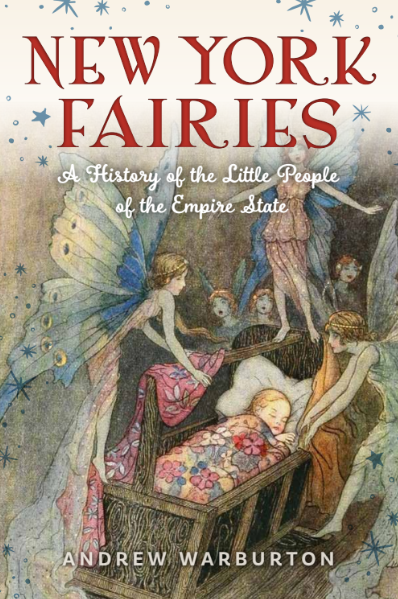
Here I want to introduce some of the people I’ve written about in my book New York Fairies: A History of the Little People of the Empire State. Believe it or not, New Yorkers have encountered fairies in every corner of the state. Unsurprisingly, many of these people were first-generation Irish Americans. However, people from various ethnic communities have met the fairies or told stories about them, including the Tuscarora in Niagara County and Welsh immigrants in Oneida County.
Hugh Duffy
Hugh Duffy was a 35-year-old Irish farmer who lived with his father in Greece, a village outside Rochester, in the late nineteenth century. He met the fairies at a crossroads near Greece in the early hours of April 24, 1887, and was terrified of what they might do to him.
Luckily, that afternoon, Hugh had bought an iron kettle and was carrying it home from a wake he’d attended the night before. The fairies (whom Hugh called “the Little People”) were dancing at the crossroads, just as people did back home in Ireland. When they spotted Hugh, they took one look at his iron kettle, saluted him politely, and vanished. (The iron had driven them away!)
We know about this meeting from the diary of Irish American William Connolly, and it’s one of the few Irish American encounters with the Little People on American soil.

Irish immigrants about to board a boat for New York, published in Harper’s Weekly, 1874.
John Marman
A first-generation Irish American carpenter who lived near Albany, New York, John Marman was sitting in a rocking chair beside a crib in which his son was sleeping when he sensed movement in the crib: something was tugging at the child’s bed clothes. Jumping up, John yelled hoarsely. He waited, alert for movement in the shadows, when a “tiny bit of a wee girl” scampered out of the room through the keyhole! John had apparently seen a fairy.
This is the tale John’s granddaughter May told to the folklorist Louis Jones in the 1940s, although the events must have taken place in about the 1870s. May said her grandfather had believed that the little fairy was about to steal his son and replace him with a fairy changeling.

Photo believed to be of John Marman and family.
Mary Nell
Of all the fairy-haunted New Yorkers I’ve written about in the book, Mary Nell is by far the most tragic. In 1863, after her husband was called to Washington, D.C., to serve in the Civil War, leaving her alone with their four-year-old son John, she apparently experienced a psychotic breakdown and suffered from the delusion that the fairies had replaced John with a fairy baby (that is, a fairy changeling).
Sadly, the traditional method for driving out a changeling was to place the child on a red-hot shovel. This Mary did, inadvertently killing poor John. She later spent time in the New York City Lunatic Asylum on Roosevelt Island and lived as a widow in Manhattan.
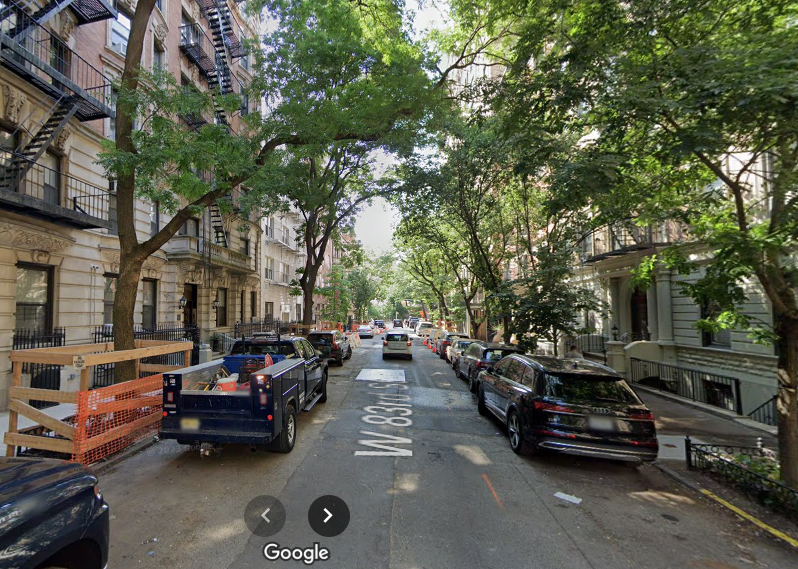
West 83rd St between Eleventh and Twelfth Avenue in the Upper West Side, where Mary Nell lived. The buildings shown would not have existed when Mary lived there.
Eleazer Williams
In the late nineteenth century, when the great Tuscarora medicine man Eleazer Williams was still a boy, his father would go to work cutting trees and would leave him at a “double-stemmed oak” on the Tuscarora Reservation in Niagara County, New York. As soon as his father’s carriage had rolled away, Little People would emerge from behind the oak and play with him all day. When Eleazer became an adult and later a renowned healer, he was rumored to possess a Little Person guide who taught him his healing powers.
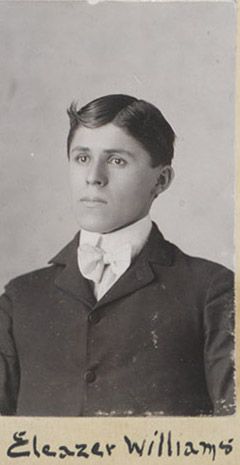
Photo of Eleazer from about 1900.
Howard Thomas
In 1910, when New York folklorist Howard Thomas was ten years old, he idolized a young Welshman called Hughey who’d recently come over from Wales to join the Welsh immigrants who’d settled in towns such as Remsen in Oneida County.
This Hughey told the budding folklorist many stories about the ellyllon (a Welsh word for elves or Little People) who haunted the limeburners back home in Wales. These ellyllon loved to steal Welsh children and could be heard throwing stones in the hills on thunderous nights. Interestingly, Remsen, like Wales, was home to a strong lime-burning industry, and men liked to wrestle in the light of the lime kilns and tell stories drawn from folklore. Thomas believed that stories about the ellyllon had taken root in Remsen: he wrote a novel, The Singing Hills, in which Welsh American characters speak at length about these haunting elves.
These are just a handful of the Americans who’ve encountered fairies in New York. For a complete summary of the state’s fairy and Little People folklore, check out my book New York Fairies.


 Fairies of New England: The Little People of the Hills and Forests
Leave a comment