
In the spirit of the season (Lent and approaching Easter), I thought I’d offer the following reflection on the relationship between fairies and “dry places.”
My inspiration comes from a New England saying found in the 1896 book Current Superstitions: Collected from the Oral Tradition of English Speaking Folk by Fanny D. Bergen. The book collects all kinds of utterances and nuggets of folk wisdom common among English-speaking people in the United States in the late nineteenth century.
Among these sayings are the following pieces of lore, recorded in Salem, Massachusetts:
Run around a fairy ring twice on Easter Sunday morning, and fairies will arise and follow you.
Right before this entry is another fairy-related quote, also collected in Salem:
Dry spots, where there is no dew, are called “fairy rings.”
Unfortunately, Bergen doesn’t report who exactly offered the sayings or what they meant to the people who shared them, which makes them difficult to interpret. Nevertheless, they’re extremely suggestive.
Fairy rings or circles
In the popular imagination, the term fairy ring or fairy circle often refers to a ring of mushrooms or toadstools. But in English and Welsh folklore, it also refers to a ring of grass growing in a circle. Like the toadstools, this type of fairy ring is also caused by a fungus, but here the fungus is under the grass.
One memorable account of these grassy rings can be found in English clergyman John Christopher Atkinson’s Forty Years in a Moorland Parish (1891). As the title suggests, Atkinson worked for forty years at a parish in Yorkshire, where he recorded the folklore of his elderly parishioners.
Atkinson was particularly interested in learning about a place called Fairy Cross Plains, an open space near one of the parish’s public houses. A very elderly woman explained to him that the Plains had originally been the site of a crossroads and that the term fairy in the name referred to the fact that many grassy circles could be seen in the area. The local people (especially children and the very old) believed that fairies formed the circles when they danced in rings.
Circles of dryness?
The lore from Salem, Massachusetts, in which fairy rings are interpreted as dry circles (where no dew has fallen), appears to be unique to North America. However, it does agree with the Welsh and English understanding of fairy rings as patches of grass as opposed to rings of mushrooms.
But why is dryness associated with fairies here?
I’m reminded of one eighteenth-century belief—espoused by the dissenting (i.e., non-Anglican) Welsh minister Edmund Jones—that fairies “walk in dry places.” Jones developed this idea based on passages in St. Matthew and St. Luke, in which Jesus says the following (I quote from the King James Bible because this is the version Edmund Jones would have been familiar with):
When the unclean spirit is gone out of a man, he walketh through dry places, seeking rest, and findeth none.
Matthew 12:43.
Jones thought the term unclean spirit in this verse was in fact a reference to fairies and that dry places meant fairy rings found in grassy spots away from human dwellings (think of the Fairy Cross Plains that Atkinson saw in Yorkshire).
Of course, Jesus’ saying had a rather different meaning: his description of unclean spirits apparently refers to a process whereby religious hypocrites believe themselves to be righteous because they’ve swept their souls “clean,” causing the evil spirits within them to be cast out into “dry places”; because these hypocrites lack the Holy Spirit, the ousted spirits soon return—even more powerful than before.
What was Edmund Jones’ goal when using this passage to explain fairy rings?
My first thought is that Jones’ religious interpretation transforms what we usually think of as joyful or playful fairy dancing into something very different. According to him, it’s not dancing that creates fairy rings but rather a fruitless search for rest: fairies walk in endless circles because they cannot find a satisfactory destination (i.e., God). This is what creates the famous circles in grass, which thereby become a sign of uncleanness or godlessness. There are many examples in folklore of fairy rings being seen as dangerous, especially when the ring is crossed or danced around a certain number of times. According to one of Atkinson’s Yorkshire parishioners, children often danced around the rings on Fairy Cross Plains but always stopped before making nine circles, as that prevented the fairies gaining power over them.
For Jones, the taboo against dancing around fairy circles probably related to the rings’ spiritually unclean quality, i.e., their connection with the demonic. In his mind, uncleanness appears to be signified by the term dry, which stands in opposition to Christian ideas about living water (i.e., the Holy Spirit). Jones’ interpretation may also recall the “doleful creatures” found in Isaiah, which reside in cities turned to wastelands, and other folkloric descriptions of fairies as perpetually sad.
Dry circles in Salem, Massachusetts
Returning to Salem, I can’t help wondering if the person who described fairy rings as dry circles had read the book British Goblins by the American author Wirt Sikes. Published about fifteen years before Current Superstitions (in which the Salem circles appear), British Goblins includes a description of Edmund Jones’ fairy rings. If dry fairy rings are unique to Salem, Massachusetts (which isn’t definite), it may be that the person who shared this interpretation learned it from British Goblins; either that or the person had some living connection to the Welsh context in which Edmund Jones’ ideas existed.
But there’s more to the Salem fairy rings than simply their dryness. There’s also the unusual claim that “fairies will arise and follow you” if you dance around one twice on Easter Sunday.
This is an extremely interesting idea because it disagrees with certain ideas found elsewhere in folklore—for instance, one Scottish man’s claim that fairies are never seen on Sundays because Sunday is the Lord’s Day (cf. Evans-Wentz, The Fairy-Faith in Celtic Countries). I’m not aware of any other instances of fairy sightings being associated with Easter, although the connection between dancing around a fairy ring and seeing fairies is common.
Perhaps the most interesting thing about the saying is the way it transforms the dryness of Edmund Jones’s “unclean” fairy rings into its opposite: a kind of Easter experience. The fairies’ “arising” even echoes Jesus’ resurrection and the Easter expression “He is risen.”
Unfortunately, it’s difficult to arrive at a clear interpretation of this transformation because the book doesn’t provide any more details about it. Is the fairies’ “arising and following you” on Easter Sunday a threatening phenomenon? Edmund Jones would probably see it that way: he might even consider the imitation of unclean spirits’ fruitless walking (on Easter Sunday, of all days) to be blasphemous. Or is the phenomenon a joyful experience due to its association with Easter and resurrection? Based on other descriptions of nineteenth-century Massachusetts fairies, including one Marblehead resident’s assertion that fairies are “uniformly sweet-natured” and “live a happy life,” the latter seems more likely. Apparently, the fairies also rise at Easter.
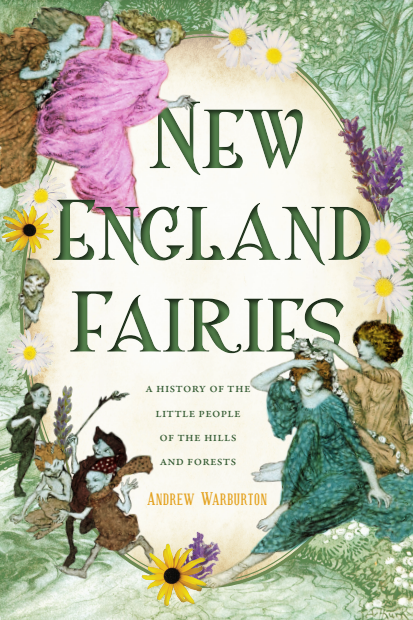
Read about more New England fairies in my book New England Fairies: A History of the Little People of the Hills and Forests.
Note: After writing this blog, I learned that the Book of Common Prayer reading for this week (the third Sunday of Lent) is, by a strange coincidence, from St. Luke and contains the words that inspired this blog in the first place: “When the unclean spirit is gone out of a man, he walketh through dry places…”
 Fairies of New England: The Little People of the Hills and Forests
Leave a comment