
At the weekend, I gave a talk on New England fairy lore at the Fortean Fest in Sanford, Maine. After the talk, a woman with clairvoyance came up to me and told me that while I was speaking, she anticipated every word I was about to say. More importantly, she claimed that one of the fairies I’d spoken about had an “attachment” to me and was following me. The fairy in question is a banshee, i.e., a female fairy, with stony blue eyes and long red hair that falls in curls down her back. The clairvoyant said that the fairy is sad (she is, after all, a banshee known for mourning the dead), but she apparently feels safe with me because of the way I speak about her.
(For the time being, I’m going to overlook the notion of an Irish banshee becoming attached to a twenty-first-century Englishman: the clairvoyant seemed to wish to reassure me of my connection to the spirit world, as I’d pointed out in my talk that I neither see fairies nor experience supernatural phenomena.)
I don’t want to say too much about this particular fairy because I plan to tell her story in my next book, but I will say one thing: one of the most interesting things about her (as mentioned in nineteenth-century descriptions) is her red hair and blue eyes. The combination of these features is extremely rare in humans and is perhaps one sign of her fairy nature. Storytellers wanting to identify a being’s fairy nature require a signifier of that nature (i.e., a trait that stands, as a metonym, for the being’s identity). The fact that red hair is able to fulfill this role can be seen in the following story from Gerald of Wales, written in the twelfth century:
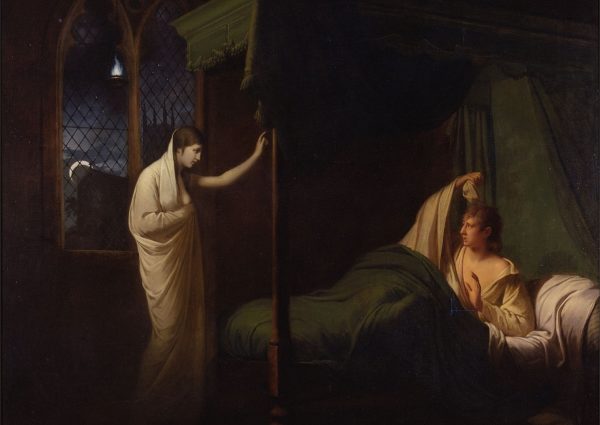
[I]n the province of Pembroke. . . [a] manifestation occurred, in the home of Elidyr of Stackpole. It took the form of a young man with red hair called Simon. This was a full incarnation, for he could be seen and touched. He removed the household keys from the man in charge of them, and with complete self-assurance, took on the job of steward. He administered the household with such foresight and attention to detail, or so it seemed, that in his hands everything prospered and nothing was ever lacking. . . He never went to church and no Christian word was ever heard on his lips. He never slept in the house, but reported for work each morning with amazing punctuality.
Then by chance he was seen one night by some member of the family conversing with his fellow-demons by the water-mill and the pool. The next morning he was interviewed by his master and mistress. He was dismissed on the spot and he handed over the keys which he had held for forty days or more. When he left they questioned him closely and asked him who he really was. He said that he had been born to some rustic beldame in the same parish, fathered on her by an incubus who had appeared in the shape of her husband.
In Simon’s story, the being’s fairy nature is first signified by his red hair and secondarily by his ability to carry out the stewardship of Elidyr’s home with supernatural success. His red hair was perhaps passed on genetically by the incubus that lay with his mother. (It should be noted, however, that all the terms Gerald uses, including demon and incubus, represent demonizations of fairies and shouldn’t be understood as referring to literal demons of Christian cosmology). Similarly, the banshee whose story I spoke about this weekend, when she was seen in the late nineteenth century, was described as having red hair and blue eyes—a combination that speaks to her fairy nature. Just as Simon became attached to Elidyr’s household and thereby became a household spirit or familiar, so the redheaded banshee, according to the clairvoyant I met, had become attached to me!
Why do fairies become attached?
Why fairies become attached to people in folklore is unclear, but it’s an undeniable phenomenon, suggesting that the fairy nature is at times intrinsically oriented toward human society. One of the banshee’s defining traits is her attachment to human families and her mourning of family members. Simon’s attachment, on the other hand, is all-encompassing, not limited to one function of the household (such as mourning) but extending to every household function: he becomes the steward of the home. The banshee, by comparison, has a particularly limited—though extremely long-lasting, i.e., multi-generational—attachment.
In his book The Tradition of Household Spirits, Claude Decouteaux gives a few reasons for fairy or spirit attachments: 1) the spirit may have inhabited the land where a home was built and may, as a result, have become attached to the household that lived there; 2) a spirit may have been brought into the home disguised as an ordinary object or may have been invited into the home by means of some ritual; and 3) a person who lived in the home may have died and become a spirit that inhabited the home. (Other motivations for fairy attachment include sexual interest or a kind of vampiric, energy-sapping relationship.) None of these means of attachment really coincide with the clairvoyant’s description of the banshee’s attachment to me, which she said arose from my willingness to share the banshee’s story. I suppose one might claim that telling a spirit’s “story” is to invite that spirit into one’s “household,” but this is far from obvious.
(The clairvoyant wouldn’t be the first person to claim that a female spirit is attached to me. A psychic once told me she could see my grandmother behind me, protecting me. She also told me I would one day write a book. Personally, I’m skeptical of many psychic claims: anyone with an ounce of spiritual wisdom might claim that a grandmother in the afterlife was protecting her still-living grandson.)
Whether the redheaded banshee is attached to me or not, I’ve not felt or seen anything that would suggest such a thing. The clairvoyant claimed that my fear of otherworldly beings meant that any clairvoyant abilities I possessed must be blocked. This, she said, explained my lack of awareness of the attachment. Speaking about the spirit world in such concrete terms (a defining characteristic of the paranormal community) is not something I usually do.
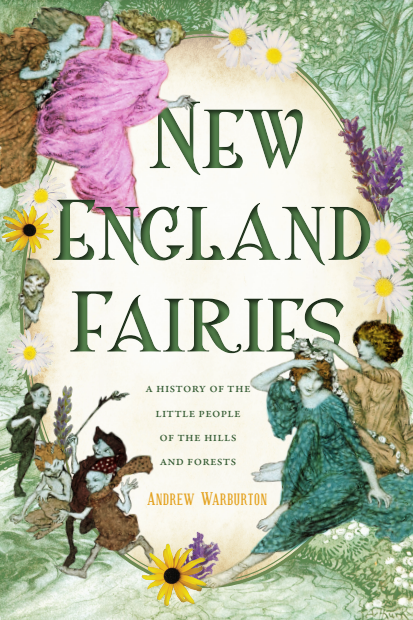
Read about more New England fairies in my book New England Fairies: A History of the Little People of the Hills and Forests.

 Fairies of New England: The Little People of the Hills and Forests
Leave a reply to Mystical Pathways: Welcoming Fairies into Your Abode – Cozy Shadow Tarot Cancel reply