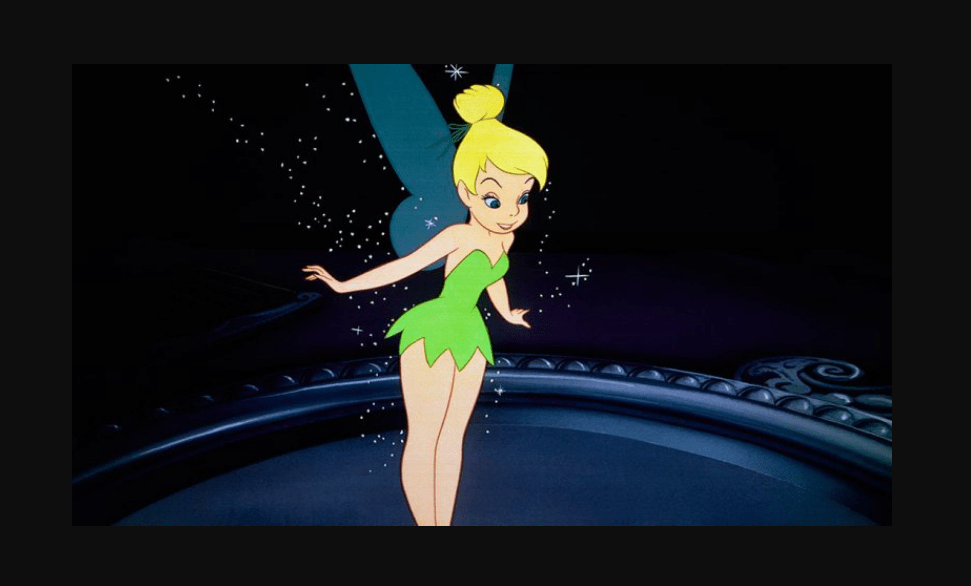
It’s an undeniable fact that Tinker Bell from J.M. Barrie’s Peter and Wendy has—for better or worse—greatly informed the modern understanding of fairies. The fairies in Peter and Wendy largely conform to the Victorian understanding of tiny winged beings with a magical aura or light surrounding them. Barrie’s fairies, like humanoid butterflies, wear magical “fairy dust” that helps them fly. (While the association between fairies and moving lights is well attested in folklore, the insectoid wings and butterfly-like dust are pure Victoriana, so I will not dwell on them below.)
I was recently looking through Peter and Wendy, so I thought now might be a good time to explore the book’s depiction of Tinker Bell. I was actually quite surprised to realize that she does conform to a “traditional” depiction of fairies in a few important ways.
Although one might argue that no single “traditional view” of fairies exists, I think there are certain traits or behaviors that we can say are either in keeping with (or departing from) common fairy folklore traditions.
So I’ll start by pointing out the similarities I noticed between “Tink,” as she’s called, and the traditional fairy, followed by the differences. (I don’t expect everyone to agree with these, so feel free to leave a comment.)
Some ways that Tinker Bell is like a traditional fairy:
Her occupation
I must admit that I never realized that the name Tinker Bell is actually a reference to her occupation. I always thought it was a reference to the tinkling of a bell (which Barrie describes as the sound of fairy language)! Peter Pan gives Tinker Bell’s occupation as follows:
“She is quite a common fairy; she is called Tinker Bell because she mends the pots and kettles.”
Being a tinker (that is, someone who mends things) seems to me to be quite a traditional fairy occupation. That’s because, in folklore, fairies often enter people’s homes at night to perform chores, thereby becoming “household spirits.” There’s also the leprechaun, of course, who mends old shoes. It seems to me that Barrie abandoned most aspects of the household spirit tradition but retained the folkloric occupation.
Her “capriciousness”
Fairies are often described as “capricious” because they seem to swing between benevolence and malevolence. That is, they bring fortune and misfortune in a way that seems, to the non-fairy, quite random. Tinker Bell is rather similar:
Tink was not all bad: or, rather, she was all bad just now, but, on the other hand, sometimes she was all good. Fairies have to be one thing or the other, because being so small they unfortunately have room for one feeling only at a time.
The only quibble I have here is that the fairies of folklore aren’t necessarily good or bad, and I’m not sure they can only be one thing at the same time. On the other hand, if we see fairies as deities of chance and accident, the one-thing-at-a-time argument does make some sense because two opposite things cannot happen at the same time, i.e., milk can’t be both sweet and sour. Perhaps Barrie is merely pointing out fairies’ allegorical nature, the fact that they’re not real, psychologically whole personalities (at least according to one view).
Her tormenting Wendy
Tinker Bell quickly takes a dislike to Wendy and decides to torment her mercilessly, usually by pinching her but also by trying to kill her:
The jealous fairy had now cast off all disguise of friendship, and was darting at her victim from every direction, pinching savagely each time she touched.
As we all know, fairies in folklore often torment people, sometimes just for fun, sometimes because the person has broken the rules of fairy decorum. Pinching also seems to be a particularly fairy-like torment, so in this way I’d say Tink is quite a traditional fairy.
Some ways that Tinker Bell is not like a traditional fairy:
Embonpoint
I had to look up the meaning of this word because I’d never seen it before! Once I looked it up, I felt that I’d learned an important piece of information about Barrie’s innovation of the fairy form. This is how he describes Tinker Bell:
It was a girl called Tinker Bell exquisitely gowned in a skeleton leaf, cut low and square, through which her figure could be seen to the best advantage. She was slightly inclined to embonpoint.
The word embonpoint literally means something like “in good condition,” but it also refers to a woman’s curvy, attractive plumpness. Barrie loves drawing attention to the manliness or womanliness of his main characters (in a way that I think draws attention to Wendy’s adolescence—the fact that she‘s becoming aware of her sexuality), and embonpoint is basically a Victorian way of saying thick, probably with similar sexual overtones.
I don’t find this to be a very traditional depiction of a fairy. While it probably has roots in Renaissance and Victorian depictions of gods and fairies, the coquettishness and sexual availability that embonpoint implies seems to be a deliberately humorous innovation. While sexually voracious fairies do exist in folklore, the “sexy fairy” whose garments show off her figure to the “best advantage” seems to be a Victorian invention preoccupied with a particular type of male gaze (as well as being funny, considering Tink’s size and fairy nature).
The influence of this type of coquettishly performative and humorous fairy can be felt massively in the modern era: in the depiction of the Green Fairy in the movie Moulin Rouge (played by Kylie Minogue), for example. (That fairy is actually a depiction of the Green Fairy used to advertise absinthe but as if she were Disney’s Tinker Bell.)

Her boudoir
Barrie describes Tinker Bell’s boudoir in a very stereotypical way:
there was one recess in the wall, no larger than a bird-cage, which was the private apartment of Tinker Bell. It could be shut off from the rest of the home by a tiny curtain, which Tink, who was most fastidious, always kept drawn when dressing or undressing. No woman, however large, could have had a more exquisite boudoir and bedchamber combined.
While Tinker Bell’s fastidiousness is definitely a nod to traditional fairy folklore (the fairies apparently love cleanliness and flee at the sight of mess), her boudoir represents Barrie’s humorous humanization of a fairy habitat. The apartment’s “feminine mystique,” separated by a curtain for privacy, seems at odds with everyday folklore—a deliberate attempt on Barrie’s part to inject incongruence into the story.
In folklore, fairies are often found in caves, wild places, and underground, although they also inhabit palaces and castles. Barrie seemed determined to make Tinker Bell into the equivalent of a fancy lady. Perhaps there’s a nod to Titania in the way that Tink’s possessions are made of rarefied natural objects, but Barrie’s descriptions are deliberately less dignified than Shakespeare’s.
Her moods
Tinker Bell definitely conforms to negative Victorian stereotypes about women, which may have got a laugh out of Barrie and his audience. She’s jealous, prone to hysterical mood swings (especially where other women are concerned), and egotistical. Her emotions are highly dependent on her egotism and change according to the extent to which she gets what she wants.
I cannot recall folkloric depictions of fairies in which they conform to petty gender stereotypes. While fairies may play pranks on others and may sometimes appear quite emotional, they don’t really possess the types of stereotyped emotions that the Victorians apparently associated with women (that is, jealousy of other women, “female” capriciousness, and mood swings). These are all traits that Barrie projected onto fairies.
By way of contrast, if we look at Shakespearean fairies, we can see that they’re not really stereotypical: Titania and Oberon are definite equals, and if anything, Oberon is inclined to the type of jealousy and possessiveness that Victorians later associated with women.
That’s all I’ve got on Tinker Bell for now. What are your thoughts on her (undeniably influential) place in the history of fairies?
Read about more fairies in my book New England Fairies: A History of the Little People of the Hills and Forests.


 Fairies of New England: The Little People of the Hills and Forests
Leave a reply to Christine Avon Cancel reply