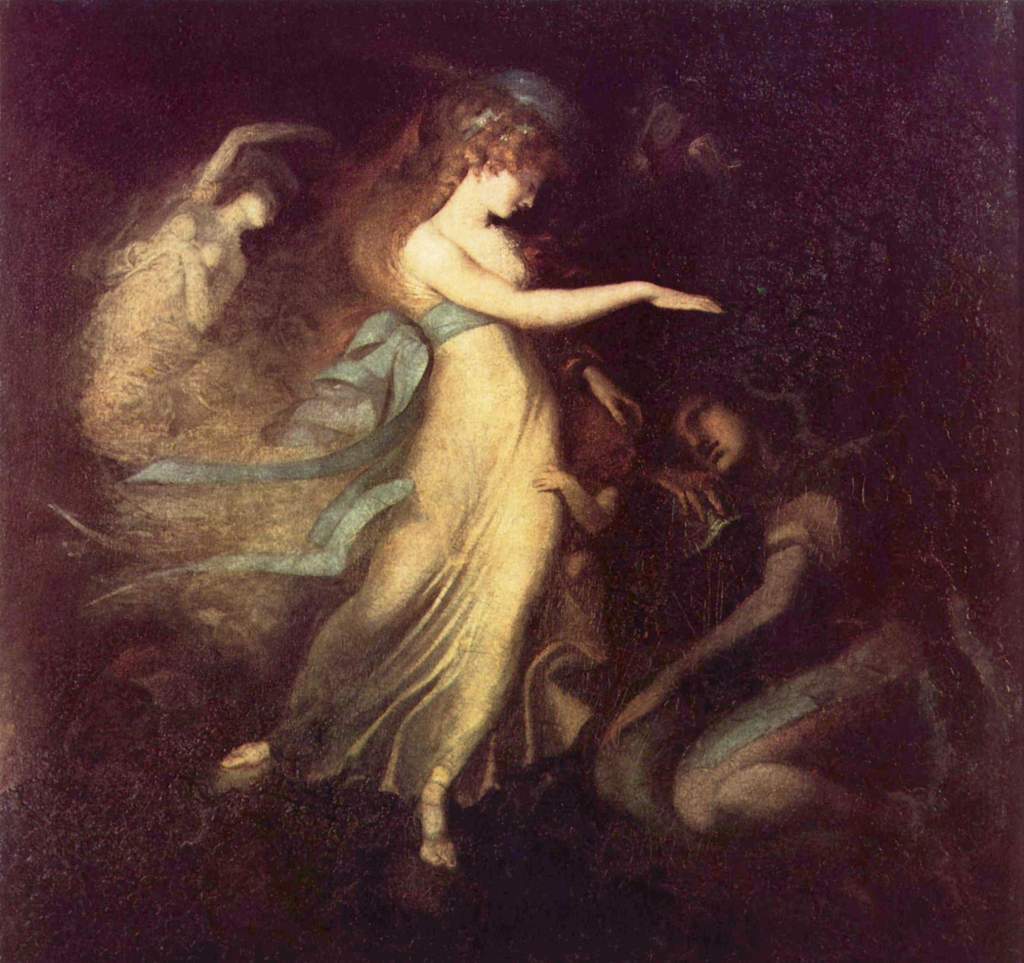
Toward the end of his book Twilight of the Godlings, folklorist Francis Young writes about medieval romance as a genre that deals with fatalitas, a Late Latin word referring to the realm of fate and necessity. Romance and fairy tales exist within the realm of fatalitas because the characters found in these genres are subject to enchantment and the vicissitudes of fortune; their stories demonstrate how fate determines the outcome of people’s lives, for better or for worse. They also reassure us that a happy ending is possible.
The fairy stories of common folk also represent the operations of fatalitas but in a less sophisticated (literary) way. Whether striking people down with sickness or bestowing on them good fortune, the fairies of folklore embody the fluctuations of fatalitas by initiating causation that lies beyond our control. According to Young, the precursors to the fairies were the fatae,1 another Late Latin (or Romance) word referring to beings who personified the utterances of the Fates. As such, the actions of the fatae had the force of law: when the Fates spoke, the fatae ineluctably shaped the lives of men. In this sense, the fatae were embodiments of fatalitas, and the fairies of the modern world (as successors of the fatae) are personifications of the life-altering influences that exist beyond our control.
The role of the fairies in the workings of fate suggests that fate and enchantment may actually be the same thing. This is because the action of magical beings operates behind the curtain of fate, without which fate wouldn’t exist as such. In this light, fate itself may be the ultimate enchantment, exerting supreme control through its various representatives. Whatever actions we take to outrun these representatives, they always overtake us, deciding the outcome of things. Similarly, we may take precautions against fairies, but a “bad fairy” may always be lurking in the shadows, waiting to trip us up.
The world’s religions have long been preoccupied with how people can be happy and behave well in a world governed by fatalitas. In this, they treat fatalitas with greater seriousness than fairy tales do, for whereas the latter reassure us that fatalitas can have a happy ending, religion tries to solve the problem of fatalitas at the root. In this, religion begins with the recognition that the ultimate effect (and symbol) of fatalitas is death, for death is a curse that hangs over us, and for much of our lives it’s as if we’re sleeping under this curse. As Seneca wrote in his Epistles:
What man can you show me who places any value on his time, who reckons the worth of each day, who understands that he is dying daily? For we are mistaken when we look forward to death; the major portion of death has already passed. Whatever years lie behind us are in death’s hands.2
The English word fatality perfectly captures the relationship between fate and death, for it refers to both “a death caused by accident” and “helplessness before fate.” If death is our fate, our subjection to fate is also subjection to death. Similarly, if fate is enchantment, the one who finds himself enchanted with life (that is, the ups and downs of fortune) is also enchanted with fate and with the false notion that death is something deferred, something that isn’t actually affecting us now. In order to wake up from the enchantment of fatalitas, we must become disenchanted with fate and fortune and with our false conceptions of death. This is perhaps the goal of Seneca’s stoicism.
The Christian faith dramatizes the relationship between death and fate when it depicts Adam and Eve eating from the Tree of the Knowledge of Good and Evil in Paradise. Before they ate the fruit, the first couple existed in a world free of fate. After eating the fruit, they initiated the chain of fate and death for the whole human race. It wasn’t until Christ was born, suffered and died that the effects of fatalitas were rendered, if not non-existent, then ultimately irrelevant, for immortal life had succeeded death. This doesn’t mean that the Christian fell into a type of passivity where everything in life was fatalitas and one’s mind was fixed on heaven. The divine was meant to enter into the world of fatalitas and create change within it, while faith allowed for a discernment of divinity within the world of fatalitas.
A very different response to the hold that fatalitas exerts over us can be seen in the actions of the ceremonial magician in sixteenth-century England. Some magicians believed that they could summon a fairy queen called Sybilia into a crystal or candle flame and thereby learn her secrets. They did this in order to ask her questions about hidden things, including the location of buried treasure. As the fairy queen was a worker of fate, her knowledge of hidden things was thought to be greater than that of the magician, for she was responsible for carrying out fate’s dictates. She could, therefore, discern truth and reverse fortunes.
Although the ceremonial magician performed his rituals in the name of Jesus Christ and exerted power over spirits through a God-given authority, his approach to fatalitas differed greatly from the Christian approach mentioned earlier. Whereas the Christian witnessed divinity flowing into the world of fatalitas through God’s grace, the magician bent fate itself to his will. We see this in the words he used to communicate with Sybilia, reminding her that “whenever and wherever I invoke you, may you be ready for me and at once obey…” Although a meal was sometimes laid out as an offering to the queen, suggesting a fair transaction, the words of the ceremony leave no doubt about the magician’s ultimate control. The goal of the ceremony (to discover hidden treasure or locate stolen goods) demonstrates that the magician wasn’t particularly interested in liberation from fatalitas but rather from its uncertainty.
We might argue that the magician’s desire to master fate is understandable because we all wish to be released from fate’s misfortunes. However, the desire to master fate may actually have caused the magician to sink deeper into its mire. Whereas the magician was previously a victim of fate, he now possessed a knowledge of fate’s workings, which allowed him to benefit from them. In this, he didn’t actually experience anything beyond fatalitas; he merely became skilled in cooperating with it. For this reason, the magician’s actions are incompatible with the virtues of faith (i.e., the discernment of God’s working in the world) and hope (for the power of the magician’s will has replaced hope). It’s also not conducive to love, for isn’t love about paying attention to those who suffer from subjection to fatalitas? I would further argue that the magician’s revelations can only cause others to become more deeply mired in the vicissitudes of fatalitas, for he cannot teach a genuinely consoling perspective.
The magician’s mastery of fate, I would argue, operates on the same mental level as fairy tales, for he longs for the reassurance of fairy tale endings. The only difference between magic and fairy tales is that the former clothes with reality those things which, in the fairy tale, were fantasy. In their essence, however, they aim for the same thing. The magician is just as much subject to Freud’s pleasure principle as a fantasist who satisfies himself with imagined fulfillment. This is why so many of the magician’s goals seem childish. There’s a reason we read fairy tales to children: they educate them in the outcomes of fate while helping them to master anxieties associated with uncertainty. But fairy tales hardly teach a higher-level perspective on fate, and children rarely develop stoicism or the virtues of faith, hope, and love. This is why such tales occupy an ambiguous position in our culture: on the one hand, we value them as educative, and on the other, we regard them as a lowly art form associated with childhood.
As for the magician’s treatment of the fairy queen, how can a genuine spiritual practice involve itself in conjuration and obeisance to another being’s will? Subjecting the fairy queen to the magician’s will hardly respects her dignity, especially when the will in question (despite invoking the name of Jesus Christ) has been shown to be inconsistent with the above-named virtues. Surely it’s better to respect the queen as a being with a job to do. Either leave her alone or honor her in whatever way you see fit. But it seems beneath our dignity as human beings to become her master or her henchman.
Read about more fairies in my book New England Fairies: A History of the Little People of the Hills and Forests.
- I use the word fatae, plural of feminine singular fata, here, but the word in Late Latin would originally have been a plural fata (from singular fatum). Around the time that Latin was developing into Romance, the neuter plural fata gave birth to a feminine singular fata, as seen in an inscription from the Italian Alps. By 1200, the singular fata was used commonly in the south of France, as attested by Gervase of Tilbury. ↩︎
- Quem mihi dabis, qui aliquod pretium tempori ponat, qui diem aestimet, qui intellegat se cotidie mori? In hoc enim fallimur, quod mortem prospicimus; magna pars eius iam praeterit. Quicquid aetatis retro est, mors tenet. ↩︎

 Fairies of New England: The Little People of the Hills and Forests
Leave a reply to Looking for the fairy “muse” at haunted Chanctonbury Ring – Fairies of New England: The Little People of the Hills and Forests Cancel reply