
NB. In this post, I use the term Fairy to describe a condition, state, or influence. However, it also refers to a discourse, that is, a set of understandings, references, and connotations related to fairy tales; it’s the use of this discourse I wish to examine in this post.
I recently wrote a Facebook post about Queen Alexandra of the United Kingdom (1844-1925), having coming across a number of books and articles referring to her as “Britain’s fairy queen,” a “fairy godmother,” a “Christmas fairy” and (this last one being a quote from Queen Victoria) “the Fairy.”
Alexandra had been on my “radar” for a while—mainly because of a 1902 Latin translation I own of the Book of Common Prayer, in which the reader is asked to pray (at morning and evening prayer) that God will enrich with grace clementem reginam nostram Alexandram, “our gracious queen Alexandra.” Otherwise, I didn’t know much about her.
As you can imagine, I had to investigate why this queen was known as a fairy queen: What I learned taught me a few things about the role of Fairy in the Victorian and Edwardian imagination, especially in its Christian guise.
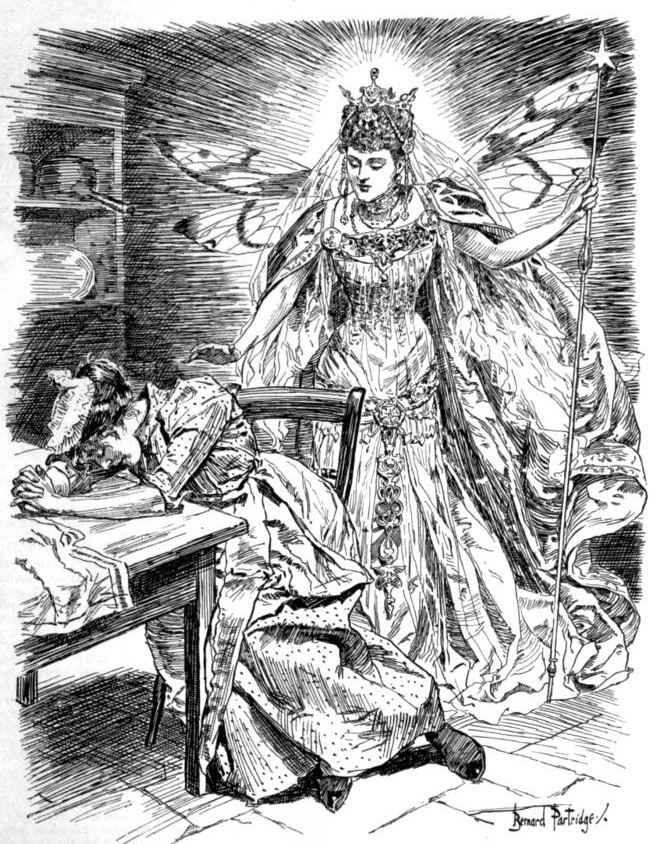
Queen Alexandra depicted as a fairy godmother in a 1902 edition of Punch.
Why did the Victorians and Edwardians invoke “Fairy”?
My reason for writing this post is to question why the Victorians and Edwardians enlisted the discourse of Fairy at special moments in the life of Queen Alexandra and, by extension, the nation. Examining those moments when commentators invoked Fairy to describe her—that is, when they called her a fairy or fairy godmother—one finds the following:
- Her life is described as fairy-tale-like due to its rags-to-riches nature and the fact that beauty and nobility surrounded her as a child despite being “poor.” This is because her childhood was marked by a mixture of poverty and riches: although she lived in a palace, her family wasn’t wealthy. Her father and mother relied on the support of the Danish royal family, lived in a grace-and-favor property, and went without the luxuries often associated with nobility. At the same time, Hans Christian Andersen was said to have visited the Yellow Palace in Copenhagen (where she grew up in the 1840s and 1850s) and read aloud his fairy stories, giving her a life-long love of Danish fairy tales. In this atmosphere of “luxurious poverty,” Alexandra experienced a “fairy-tale” childhood—surrounded, in summer, by “roses and magnolias,” and, in winter, by “the sound of sleigh-bells” (Dangerfield, Victoria’s Heir, p. 122).
- When the “impoverished” Danish princess married the heir to the British throne and became the Princess of Wales (which she remained for thirty eight years), her mother-in-law Queen Victoria apparently called her “the Fairy” because of her extreme elegance and beauty.
- In 1902, a cartoonist in Punch magazine depicted her as a “fairy godmother” in the act of inviting poor housemaids to Buckingham Palace to celebrate her coronation.
- In December 1915, during the Great War, Alexandra served tea and sandwiches to soldiers returning from the front, inspiring one commentator to describe her as a “Christmas fairy.” Such acts made her extremely popular with the British public.
- When she died in 1925, American newspapers reported the news with headlines such as “Britain mourns its ‘fairy queen.’”
Based on these examples, we can conclude that Victorian and Edwardian commentators invoked Fairy when confronted with one of the following events in Alexandra’s life: a) a positive and dramatic reversal of fortune, b) a suspension of fate (which includes the “fated” class system and the arbitrariness of birth), and c) a paradoxical combination of nobility and poverty. (In this post, I won’t address the issue of Fairy’s relationship to beauty, as I’d argue that’s a separate topic). These events apparently surpassed the norms of Victorian society in such a way that the discourse of Fairy was thought useful for understanding them.
Regarding (a) reversals of fortune, Alexandra’s life participated in Fairy because she experienced a Cinderella-like transformation from rags to riches; this transformation gave her the insight and empathy required to create (temporary) reversals of fortune in the lives of her poor subjects. Regarding (b) the suspension of fate, Alexandra “became” a fairy when she served tea to common soldiers, for her actions suspended (temporarily) the laws of Fate. In the nineteenth century, Fate was experienced through the economic and social forces of Britain’s class system, for housemaids were not fated to attend Buckingham Palace functions and queens were not fated to serve soldiers tea; Fairy made this possible. As for (c) the paradoxical combination of nobility and poverty, this is a feature of fairy tales such as “Cinderella,” in which a princess lives the life of a servant or, vice versa, a servant becomes a queen; this motif can be seen not only in descriptions of Alexandra’s childhood but also in the concept of poor housemaids becoming the Queen’s guests.
In each of these life events, we see a proximity between poverty and nobility that, in the context of Victorian understandings of society, can only be explained in terms of Fairy. Fairy, then, appeared to name a fantasy in which fated class differences were reversed, whether temporarily (in the case of the housemaids) or permanently (in the case of Alexandra herself). (Of course, the fate of the Victorian working class could never be permanently annulled, as this would amount to social dissolution or revolution. However, the discourse of Fairy enabled the impossibility of class reconciliation to be overcome.)
This doesn’t mean that Fairy, as a Victorian fantasy, remained at the level of thought or literature. It’s important to acknowledge that Alexandra, as a representative of the British monarchy (and by extension the social order), enacted this fantasy. Fairy was certainly a literary phenomenon (for it described Alexandra in a way that gave her symbolic significance), but it also became concrete in the form of a suspension of social rigidity. This enacted fantasy presumably legitimized the monarchical state and made life more livable for those existing in a class-based society.
The Christian nature of this Fairy fantasy
Enacting fantasies of class reconciliation is not exclusive to Christian societies (the Romans celebrated Saturnalia, of course, in which masters and slaves feasted together or swapped roles), but Alexandra’s act of serving her subjects was clearly meant to evoke Christian charity. The scriptures are full of fortunate reversals, from the parable of Lazarus and the rich man in Luke 16 to the pauperes sitting with principes in Vulgate Psalm 112. Medieval hagiographies demonstrate the surprising and exemplary charity of kings, queens, and bishops bringing food or riches to the poor. In these sources, the reversal of poverty and wealth served as a sign or presentiment of Heaven, where want and greed didn’t exist.
Using Fairy as a cipher for Christian charity in its mystical aspect appears to have gained a new impetus in the Victorian and Edwardian era. Behind this impetus may have been the desire to depict charity’s mystical dimension without resorting to overtly religious language: In the person of Queen Alexandra, the Messianic symbol (of pauperes sitting with principes) was transformed into a Fairy image. We see a similar development in Victorian children’s literature, where Fairy was used as a cipher for Christian truths: In Charles Kingsley’s The Water-Babies, for example (which I’ve written about here) we see Fairy (or the imagination, which is the mind’s Fairy power) as a panacea for social ills. This is similar to the depiction of Queen Alexandra’s Fairy nature as having the power (temporarily) to transform her subjects’ poverty.
Despite this apparent movement beyond overtly religious terminology, the Victorian use of Fairy was nevertheless thoroughly Christian, for it deployed Fairy in the service of a future state (the heavenly). In this context, Queen Alexandra’s charity had to remain temporary because it only aimed to symbolize the future, even as it allowed the poor (as well as the rich) to experience this future in the imperfect present. If the act of charity moved beyond the temporary, exhausting itself in an absolute transformation of reality, it could no longer symbolize a state that couldn’t be manifested fully, i.e., the heavenly.
The fairy godmothers of traditional fairy tales differed from the fairy persona of Queen Alexandra in that they often rewarded the good absolutely in this life, causing permanent reversals of fortune. This is what we call “the happy ending.” While the desire to depict goodness rewarded and evil punished may have been inherently Christian, partaking in what the novelist Samuel Richardson called a (false) poetical justice, the concept of Fairy invoked in Queen Alexandra’s fairy godmother persona appears to have been more intrinsically Christian. This is because, being temporary and mystical, it aimed for something other than “the happy ending,” manifesting charity in a divided/conflicted world while pointing to a future state. There was admittedly something inherently conservative, from a social perspective, in this vision of Fairy, for it tied charity’s “mystical heart” to the established social order and a representative of the state (the Queen). It thereby added a mystical dimension to society—without creating change. This is a recognized function of sacred monarchy.
That other “Victorian,” Karl Marx, on the other hand, may have described this process as a mystification of social forces. In The Communist Manifesto, his depiction of communism as a specter (ein Gespenst) haunting Europe appears to lampoon the bourgeois tendency to mystify concrete processes using supernatural discourse.
Read about more fairies in my book New England Fairies: A History of the Little People of the Hills and Forests.



 Fairies of New England: The Little People of the Hills and Forests
Leave a comment