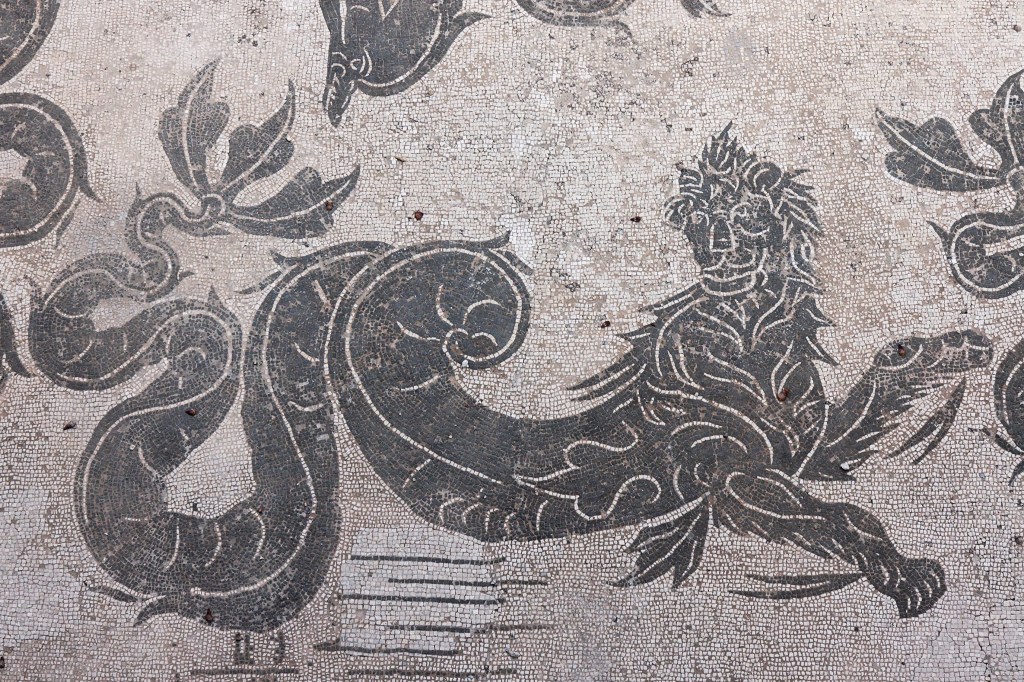
I had the good fortune recently of being on a panel at Fan Expo Boston with Sam Baltrusis and Ronny Le Blanc, both well-known authors and television personalities in the field of the paranormal. The panel was called Monsters of New England, which inevitably got me thinking about the question, “What is a monster?” and wondering how it might relate to my work on fairies.
My first thought was that monster derives from Latin monstrum, which apparently relates to two verbs, monere (to warn) and monstrare (to show). The Romans believed that a monster was essentially something that “showed itself” in order to provide a “warning.” This spectacle usually involved some abnormality of nature.
According to this ancient definition of monster, it seems that the monster itself wasn’t originally the thing one ought to fear. Rather, the monster was the harbinger of the feared thing. Although the monster might take a concrete form, its identity, as monster, depended on that to which it pointed. In this way, a monster is somewhat insubstantial, lacking in self-sufficiency, and almost like a dream (think of pharaoh’s monstrous dream of seven sickly cows devouring seven fat cows in Genesis. The events of the dream have no meaning outside of the seven years of famine they signify).
Turning to our modern understanding of a monster, we can see that our definition has somewhat changed. Rather than seeing a monster as merely the sign of a feared thing, we now define a monster as the harmful thing itself. We see here a shift in our understanding of supernatural beings—from viewing them as harbingers (like a banshee) to viewing them as substantial threats. Anthropologist Willard Walker observed this shift in his analysis of Passamaquoddy Little People folklore: whereas the appearance of the Little People once warned the tribe of danger, by the 1960s they often represented the danger itself. (In the case of the banshee, just mentioned, this shift has never taken place: the banshee remains a harbinger, not inflicting harm herself.)
My understanding of monsters has also been informed by Alaric Hall’s categorization of supernatural beings, which appears in the following Venn diagram from his book Elves in Anglo-Saxon England.

As you can see, for Hall, Anglo-Saxon thinking had room for two types of supernatural beings: “monstrous beings” and “human-like beings” (this latter type was included, alongside humans, in a larger category of the human and human-like, which included the elves). The attitude one took toward these beings followed from one’s understanding of the beings’ nature: Both monsters and human-like beings (that is, the fairies and elves) are supernatural, but in the case of the latter, the fairies and elves, we identify with them to some extent and see them as capable of relationship. This accounts for the multitude of stories from folklore about human beings eating with fairies, dancing with them, recording their music, learning healing powers from them, and even sleeping with them. In the case of monsters, on the other hand, we never identify with them or relate to them in any way, except, perhaps, to destroy them.
Witches
This got me thinking about witches. When you research fairy folklore, you can’t help encountering stories about witches because they exist in the same milieu.
But what are witches? Are they monsters? Most people today would probably say that they’re not. The term witch has been massively reappropriated—to the extent that it often has a positive connotation. This meaning of witch clearly draws on the history of witch doctors and healers who, for hundreds of years, helped their communities with treatments and cures, especially in places like Appalachia where doctors were scarce.
However, this understanding of witch shouldn’t cause us to forget that for at least two hundred years after the witch hysteria of the seventeenth century, witches in the popular imagination continued to be malevolent supernatural beings that verged on the non-human. Yes, they were often identified with actual men and women, but they were also thought to do fairy-like things such as making their homes in eggshells and traveling in subtle forms through tiny cracks. People genuinely feared the harm they thought these witches could do.
According to the more ancient definition of a witch, then, can witches be called monsters? Still not, I’d argue, because witches were always human-like. Even when they weren’t identified with particular human beings—that is, when they occupied the position of amorphous otherworldly beings—their nature never precluded identification or relationship.
Returning to our understanding of a monster as something that shows itself in order to do harm, we might conclude that witches are more dangerous than monsters. This is because monsters always show themselves as they are: harmful beings (hence, the meaning of monstrare, “to show”). In this way, they can often be avoided. The witch, on the other hand, always comes disguised. He or she appears human-like, and we can’t help identifying with him or her to some extent. The witch may even be a member of one’s extended family. In reality, though, the witch has a harmful nature that he or she shares with a monster. This means that the witch appears to straddle the categories proposed (above) by Alaric Hall: he or she is both human-like and monstrous.
Fairies
Where do fairies fit into all this? I think fairies are much more complicated than witches because they don’t have a clearly malevolent nature, although they may do malevolent things. In folklore, people have used many of the same treatments against fairies as they have against witches: in Pennsylvania, for example, people would break leftover eggshells to stop witches from making their homes in them, or they’d use iron as a protective charm.
But fairies have never been seen in quite the same universally negative light as witches. Whereas fairies bestow luck and even riches, witches, as far as I know, never do this.
That being said, folklore shows a clear pattern of demonizing fairies over time (that is, pushing them out of the human-like category toward the monstrous). We see this in New England folklore in the case of pukwudgies. These beings were originally understood to be Little People who (in Ojibwe folklore) were ancestrally related to human beings. They’re now depicted as hairy, troll-like cryptids, with glowing red eyes, who follow people home and peer at them through their bedroom windows. This shift can be represented as follows (using another of Alaric Hall’s figures):

Another example of fairy demonization is the case of imps in sixteenth and seventeenth century England, which British fairy folklore expert John Kruse has written about here. Imps are diabolical familiars, aligned with the devil (the ultimate monster), but they may have begun as offshoots of fairy folklore—perhaps a Calvinistic demonization of a healer’s fairy helpers.
To read about the appearance of both fairies and imps in American folklore, check out my book New York Fairies: A History of the Little People of the Empire State.

 Fairies of New England: The Little People of the Hills and Forests
Leave a comment