At book talks and signings, I’ve been quite open with people about the fact that I’ve never seen a fairy and that I’m agnostic as to their existence. In my books, I treat fairy folklore as a set of stories, practices, ideas, and beliefs propagated through oral and written culture. This helps me keep my intended audience as wide as possible: I don’t assume that someone who reads my books actually believes in fairies and I invite everyone, including nonbelievers, to learn about the history of fairy folklore in the United States.
That being said, I recently read Jeremy Harte’s Fairy Encounters in Medieval England, in which Harte makes an interesting claim: He says that historians ought to treat reports of supernatural encounters in the same way that historians in other fields (such as military or social history) treat their primary sources. Unless they have reason to doubt them, historians in those fields generally assume that their sources refer to a lived reality, which the historian is interested to reveal. When it comes to reports of supernatural encounters, on the other hand, historians tend to shift gears and treat their sources as “texts” or “stories.” The argument that “fairy encounters” are subjective and therefore cannot be treated as “real events” doesn’t cut it when you consider that plenty of subjective experiences are immediately accepted as lived. Even if a historian doesn’t believe in fairies, the person they’re writing about may well have had an experience that they believe was a fairy encounter. This is how Harte frames the issue:
[D]isciplinary honour [unfortunately] demands that we commit to the autonomy of the written work and are not led astray by its hypothetical origins. . . In studying fairies—unlike, say, agriculture or war—the rule has been to foreground writing as writing, so that a report of someone’s experience is not treated at all differently from a romance or fable. The proper focus of discussion, one gathers, is what the preacher or historian thought as they sat describing these things in their study, not the voice of the people to whom they actually happened. Would it be so naive to turn from the art or artlessness of these texts and look instead at the original narratives from which they derive?
For Harte, any history of medieval supernatural encounters that privileges the writings of monks and priests over the vernacular (English) tradition is likely to be erroneous. That’s because monks and priests recorded and interpreted encounters that were originally expressed orally in the vernacular. These educated men aimed to translate vernacular reports into Latin in a way that made them acceptable (or legible) to Christian culture; that is, they usually inserted them into miracle narratives, moral examples, and sermons. Of course, in doing this, they interpreted interactions with supernatural beings in Christian theological or moral terms. Thus, to read these texts at face value means losing the vernacular traditions that informed them. A more accurate way of reading these texts would involve demonstrating how the writers frame vernacular accounts in a Latin/Christian register and then show how the vernacular tradition escapes them (more on that below).
I found Harte’s approach interesting because my college degrees are in English literature and, as a student, I adored Jacques Derrida, who taught that il n’y a pas de hors-texte (“there is nothing outside the text,” or “there is no outside-text”; Harte himself references this quote in his introduction). As students of literature, we’re generally taught to treat texts as texts rather than look for an “outside-text” that wields explanatory, ontological, or signifying power. Whatever someone’s view on this is, it’s clear that many scholars approach the “written work,” as Harte points out, as if it had a signifying “autonomy.” By doing this, they risk suppressing the non-literary aspects of literature and history.
My “encounter”
With this in mind, I thought I’d attempt to describe an encounter of my own. This will offer me the opportunity to explore one of Harte’s preoccupations: the difference between encounters in stories and encounters as real events: I know the encounter is a real event because it happened to me, and in this, it differs importantly from someone else’s encounter with a fairy, which I can only ever experience as something told. (My encounter is a story for you and your encounter is a story for me; it’s only when I interpret my own encounter that it becomes a story for me, as we’ll see.) The encounter in question concerns a mysterious “being” that appeared to me when I was about nineteen years old. I won’t claim that this “being” existed (I personally think it was probably a product of my mind), but it did appear to my sight, and I think I can therefore call it an “encounter.”
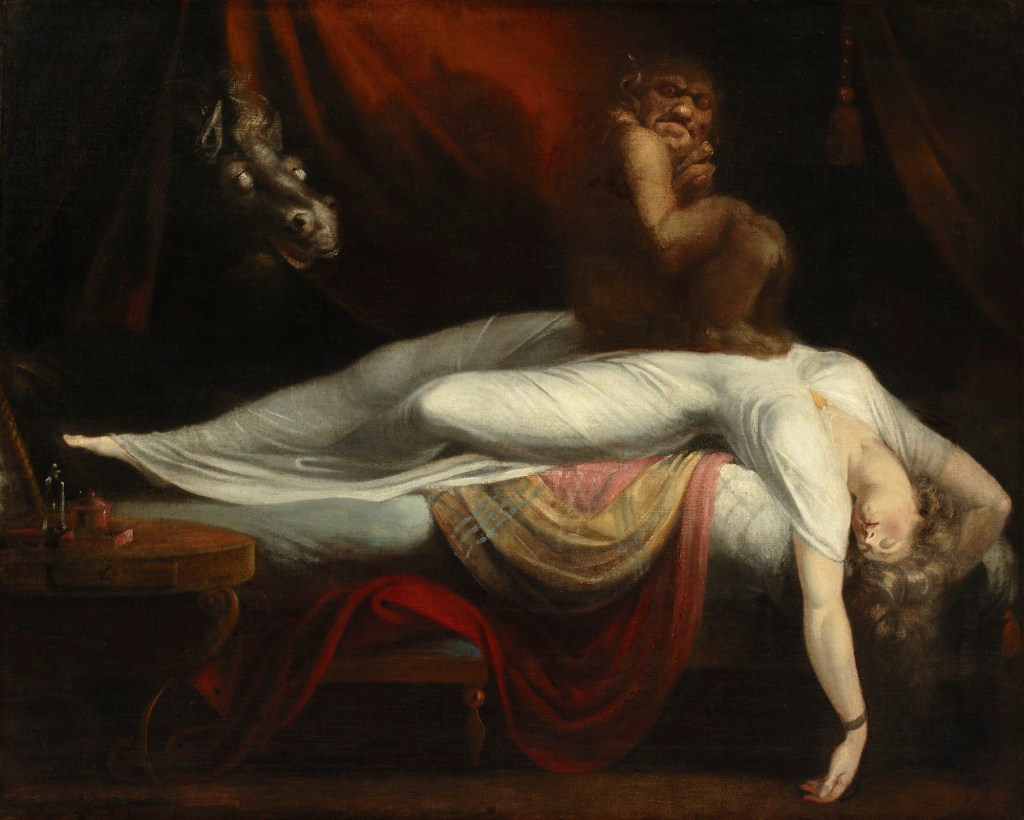
This hallucination, if that’s what it was, appeared during an episode of sleep paralysis that I experienced, sometime in the late morning, in a house (actually, a ground-floor flat) on Chertsey Road in the neighborhood of Redland in Bristol, England. My partner had gone to work, leaving me alone with a guest with whom we’d been drinking (probably heavily) the night before. For some reason, the guest’s proximity unsettled me, and it was perhaps a combination of this, and my propensity for sleep paralysis, that explains what happened next: I woke up lying on my back (not a good position for sleep paralysis) and realized I was unable to move. The bedroom door was wide open and beside the bed stood a dwarf, about four feet tall, with a face displaying no recognizable features. I could see neither eyes, mouth, nor nose, but instead a mess of wounds and gashes. Whether these were actual wounds or simply my mind’s way of interpreting a lack of features, I’m not sure. The dwarf didn’t do anything except stand and watch me from the open door. Eventually, it vanished, the paralysis having worn off.
What was this dwarf? Some people might call it a “sleep paralysis demon.” (This is a figure of social-media folklore usually evoked to satirize somebody: It’s a well-known fact that people who experience sleep paralysis often sense an evil presence in the room; satire involving “sleep paralysis demons” usually takes the form of a social-media reel with a caption that reads “POV: your sleep paralysis demon is [insert celebrity name].” This is accompanied by a video of a shadowy figure standing in a doorway talking in the voice of the satirized person. In contrast, my sleep paralysis demon didn’t speak a word.) Other people might interpret the dwarf as a product of alcohol consumption, anxiety, or hypnagogia.
Upon awakening, hardly any time had passed before I began to interpret the dwarf as a reflection of my fear. No longer merely a mysterious figure without a face, the dwarf quickly became, in my mind, a stand-in for our guest. Not that this person was particularly scary—he wasn’t—but I didn’t know him well, and my partner had made some oblique remarks the night before that sounded, to my ears, like a warning. If the dwarf was a projection of my fear, as I’d come to believe, it seems odd that he was so small: the person staying in our home was actually very tall. That the dwarf had no face was another characteristic that didn’t fit nicely into my interpretation, but I couldn’t shake the feeling that the dwarf was connected to our guest. I’d long shifted from the realm of encounter to the realm of psychological storytelling.
There are many ways to interpret my encounter, a few of which I’ll mention in a moment. But first let’s return to Harte, for it’s interesting to see how a similar process of interpretation occurred among his Latin-educated monks. To make my dwarf legible to a Christian culture, they’d probably have called it a daemon or diabolus, or perhaps an incubus (due to its manifestation in my bedroom). They’d then have attempted to restrict the meaning of the “dwarf encounter,” as far as the story allowed, to a theological or moral context. This would have involved interpreting the dwarf as a kind of moral threat, perhaps. In doing this, the monk’s text would have obfuscated the encounter just as much as it revealed it.
Harte’s point is that medieval Latin texts rarely succeed in translating vernacular accounts in a coherent way. This is because the oral material that lies behind the Latin is so rich and strange that it resists neat insertion into a moral or theological register. An aelf (elf) or dweorf (dwarf) might be called a diabolus in a Latin text, but it will often act in ways that are inexplicable from the standpoint of Christian morality or cosmology. The strangeness of the events in the ecclesiastical texts therefore speak to the existence of a vernacular English tradition of supernatural encounters. In this way, as Harte points out, Latin texts—against their original purpose—end up being a depository for vernacular ideas about otherworld beings:
where the otherworld is concerned, medieval texts do not function as they were supposed to—they do not make the theological points that they should, they do not enforce the morality that they profess, they do not teach the historical lessons that they propose—because their literary integrity was continually subverted by pressure from the talk going on around them. Things happened, including supernatural things; stories were told, mostly in the languages of the laity; some writers wrestled to harmonize these with what they thought to be true, but most simply went with the flow, so that what we read is not very far from what they were told, even though this might contradict their views on how things should be, as reality so often does.
After reading Harte, I wondered about the extent to which we, in the modern world, are similar to those Latin-writing monks. They attempted to make sense of “encounters” in terms of theological and moral stories; we, too, face a similar dilemma. Attempting to transcribe our experiences into the frameworks available to us, we often don’t realize that what we “profess” or “propose” fails to integrate our experiences coherently. In the modern world, fewer people may transcribe their experiences into a theological register, but almost everyone makes use of some register or other. Psychoanalysis, for example, interprets experience in a way that parallels ecclesiastical culture, taking raw material and explaining it as an expression of psychological conflict (the angels and demons of days gone by). The dwarf I “encountered” in Bristol might easily be inserted into a psychodrama about fear and sexuality, possibly having to do with my being alone in an apartment with a relatively unknown guest. Or one might summon the language of somnology and neuroscience to explain it as an accident of the brain. At the core of these accounts, though, is the dwarf himself: forever faceless, mysterious, and threatening. His presence in my bedroom that morning may be slotted into a story, but ultimately he’s as resistant to interpretation as any otherworld being.


 Fairies of New England: The Little People of the Hills and Forests
Leave a reply to victoriagrimalkin Cancel reply